
Blog

  • New Era – Elementary 2 #4

    New Era – Elementary 2 #4

    body { font-family: Arial, sans-serif; margin: 0; padding: 0; background-color: #fdfdfd; } .container { max-width: 900px; margin: 20px auto; padding: 0 15px; } .tab-group { margin: 25px 0; } .tab-buttons { display: flex; justify-content: space-around; flex-wrap: wrap; gap: 8px; margin-bottom: 10px; } .tab-buttons button { padding: 10px 18px; cursor: pointer; background-color: #ffe082; border: none; border-radius: 6px; font-weight: bold; } .tab-buttons button.active { background-color: #ffca28; } .tab-content { display: none; background-color: #fff8e1; padding: 20px; border-radius: 10px; box-shadow: 0 2px 6px rgba(0,0,0,0.1); } .tab-content.active { display: block; } h2 { color: #2e7d32; margin-top: 0; } textarea { width: 100%; padding: 10px; border-radius: 6px; border: 1px solid #ccc; } .vocab-tooltip { border-bottom: 1px dotted #333; cursor: help; font-weight: bold; color: #2e7d32; } .vocab-tooltip:hover::after { content: attr(data-tooltip); position: absolute; background: #333; color: white; padding: 5px 10px; border-radius: 4px; font-size: 12px; white-space: nowrap; transform: translate(-50%, -120%); } .answer-tooltip { border-bottom: 1px dotted #666; cursor: help; font-weight: bold; color: #1976d2; } .answer-tooltip:hover::after { content: attr(data-answer); position: absolute; background: #1976d2; color: white; padding: 8px 12px; border-radius: 4px; font-size: 13px; white-space: nowrap; transform: translate(-50%, -120%); }

    A. 问答问题

    1. 认为什么样的人是智慧的人?
    2. 关于中国诗歌,你都知道什么
    3. 知道哪位有名哲学家简单介绍一下。
    4. 你能流利地说哪种语言
    5. 考过HSK吗?通过几级
    6. 哪些学习计划
    7. 希望将来什么工作

    B. 填空

    提供词语将来 来自 通过

    我叫陈新阳来自马来西亚。我喜欢中国诗歌打算将来汉语老师。我要努力学习希望二年级通过HSK6考试

    提供词语流利 哲学 计划

    喜欢中国哲学所以我来中国留学。我计划好好学习汉语希望三年级流利地说汉语,也能读懂孔子说过的话。

    C. 朗读课文(一),注意语音语调。1-2

    A. 問答問題

    1. 認為什麼樣的人是智慧的人?
    2. 關於中國詩歌,你都知道什麼
    3. 知道哪位有名哲學家簡單介紹一下。
    4. 你能流利地說哪種語言
    5. 考過HSK嗎?通過幾級
    6. 哪些學習計劃
    7. 希望將來什麼工作

    B. 填空

    提供詞語將來 來自 通過

    我叫陳新陽來自馬來西亞。我喜歡中國詩歌打算將來漢語老師。我要努力學習希望二年級通過HSK6考試

    提供詞語流利 哲學 計劃

    喜歡中國哲學所以我來中國留學。我計劃好好學習漢語希望三年級流利地說漢語,也能讀懂孔子說過的話。

    C. 朗讀課文(一),注意語音語調。1-2

    A. Q&A Questions

    1. Nǐ rènwéi shénme yàng de rén shì yǒu zhìhuì de rén?
    2. Guānyú Zhōngguó shīgē, nǐ dōu zhīdào shénme?
    3. Nǐ zhīdào nǎ wèi yǒumíng de zhéxuéjiā? Qǐng jiǎndān jièshào yīxià.
    4. Nǐ néng liúlì de shuō nǎ zhǒng yǔyán?
    5. Nǐ kǎoguò HSK ma? Tōngguòle jǐ jí?
    6. Nǐ yǒu nǎxiē xuéxí jìhuà?
    7. Nǐ xīwàng jiānglái zuò shénme gōngzuò?

    B. Fill in the Blanks

    Words provided: jiānglái láizì tōngguò

    Wǒ jiào Chén Xīnyáng, láizì Mǎláixīyà. Wǒ xǐhuān Zhōngguó shīgē, dǎsuàn jiānglái zuò Hànyǔ lǎoshī. Wǒ yào nǔlì xuéxí, xīwàng èr niánjí néng tōngguò HSK 6 jí kǎoshì.

    Words provided: liúlì zhéxué jìhuà

    Wǒ xǐhuān Zhōngguó zhéxué, suǒyǐ wǒ lái Zhōngguó liúxué. Wǒ jìhuà hǎohǎo xuéxí Hànyǔ, xīwàng dào sān niánjí néng liúlì de shuō Hànyǔ, yě néng dú dǒng Kǒngzǐ shuōguò de huà.

    C. Lǎngdú kèwén (yī), zhùyì yǔyīn yǔdiào. 1-2

    A. Q&A Questions

    1. What kind of person do you think is a wise person?
    2. What do you know about Chinese poetry?
    3. Which famous philosopher do you know? Please give a brief introduction.
    4. Which language can you speak fluently?
    5. Have you taken the HSK? What level did you pass?
    6. What study plans do you have?
    7. What work do you hope to do in the future?

    B. Fill in the Blanks

    Words provided: 将来 来自 通过

    My name is Chen Xinyang, I come from Malaysia. I like Chinese poetry and plan to be a Chinese teacher in the future. I will study hard and hope to pass the HSK Level 6 exam in my second year.

    Words provided: 流利 哲学 计划

    I like Chinese philosophy, so I came to China to study abroad. I plan to study Chinese well and hope to speak Chinese fluently by third year, and also be able to understand what Confucius said.

    C. Read Text (1) aloud, paying attention to pronunciation and intonation. 1-2

    document.querySelectorAll(‘.tab-group’).forEach(group => { const buttons = group.querySelectorAll(‘.tab-btn’); const contents = group.querySelectorAll(‘.tab-content’); buttons.forEach(button => { button.addEventListener(‘click’, () => { buttons.forEach(btn => btn.classList.remove(‘active’)); contents.forEach(content => content.classList.remove(‘active’)); button.classList.add(‘active’); document.getElementById(button.dataset.tab).classList.add(‘active’); }); }); });

  • New Era – Elementary 2 #2

    New Era – Elementary 2 #2

    body { font-family: Arial, sans-serif; margin: 0; padding: 0; background-color: #fdfdfd; } .container { max-width: 900px; margin: 20px auto; padding: 0 15px; } .tab-group { margin: 25px 0; } .tab-buttons { display: flex; justify-content: space-around; flex-wrap: wrap; gap: 8px; margin-bottom: 10px; } .tab-buttons button { padding: 10px 18px; cursor: pointer; background-color: #ffe082; border: none; border-radius: 6px; font-weight: bold; } .tab-buttons button.active { background-color: #ffca28; } .tab-content { display: none; background-color: #fff8e1; padding: 20px; border-radius: 10px; box-shadow: 0 2px 6px rgba(0,0,0,0.1); } .tab-content.active { display: block; } h2 { color: #2e7d32; margin-top: 0; } textarea { width: 100%; padding: 10px; border-radius: 6px; border: 1px solid #ccc; } .vocab-tooltip { border-bottom: 1px dotted #333; cursor: help; font-weight: bold; color: #2e7d32; } .vocab-tooltip:hover::after { content: attr(data-tooltip); position: absolute; background: #333; color: white; padding: 5px 10px; border-radius: 4px; font-size: 12px; white-space: nowrap; transform: translate(-50%, -120%); } .answer-tooltip { border-bottom: 1px dotted #666; cursor: help; font-weight: bold; color: #1976d2; } .answer-tooltip:hover::after { content: attr(data-answer); position: absolute; background: #1976d2; color: white; padding: 8px 12px; border-radius: 4px; font-size: 13px; white-space: nowrap; transform: translate(-50%, -120%); }

    课程介绍:驱动

    热身问题

    第一次见到同学,你会怎么介绍自己

    视频说一说

    • 她叫什么名字为什么叫这个名字
    • 什么专业为什么这个专业
    • 哪些计划打算

    牛刀小试

    A. 小组活动

    两人一组互相介绍自己

    1. 准备填写关键词

    • 什么名字
    • 为什么叫这个名字
    • 为什么学习汉语
    • 哪些学习计划打算
    • ……

    2. 说一说根据填好的内容互相介绍一下。

    B. 结果展示

    2—3同学班上介绍自己

    学习目标

    学完这一,你能够

    • 学会名字专业学习计划相关表达
    • 介绍自己名字专业学习计划打算
    • 介绍自己同学

    課程介紹:驅動

    熱身問題

    第一次見到同學,你會怎麼介紹自己

    視頻說一說

    • 她叫什麼名字為什麼叫這個名字
    • 什麼專業為什麼這個專業
    • 哪些計劃打算

    牛刀小試

    A. 小組活動

    兩人一組互相介紹自己

    1. 準備填寫關鍵詞

    • 什麼名字
    • 為什麼叫這個名字
    • 為什麼學習漢語
    • 哪些學習計劃打算
    • ……

    2. 說一說根據填好的內容互相介紹一下。

    B. 結果展示

    2—3同學班上介紹自己

    學習目標

    學完這一,你能夠

    • 學會名字專業學習計劃相關表達
    • 介紹自己名字專業學習計劃打算
    • 介紹自己同學

    Lesson Introduction: Qūdòng (Motivation/Drive)

    Warm-up Questions

    Dì yī cì jiàn dào xīn tóngxué, nǐ huì zěnme jièshào zìjǐ?

    Kàn shìpín, shuō yī shuō:

    • Tā jiào shénme míngzì? Wèishénme jiào zhège míngzì?
    • Tā xué shénme zhuānyè? Wèishénme xué zhège zhuānyè?
    • Tā yǒu nǎxiē jìhuà hé dǎsuàn?

    Niú Dāo Xiǎo Shì (Practice Makes Perfect)

    A. Xiǎozǔ Huódòng (Group Activity)

    Liǎng rén yī zǔ, hùxiāng jièshào zìjǐ.

    1. Zhǔnbèi: Tiánxiě guānjiàn cí.

    • Jiào shénme míngzì?
    • Wèishénme jiào zhège míngzì?
    • Wèishénme xuéxí Hànyǔ?
    • Yǒu nǎxiē xuéxí jìhuà hé dǎsuàn?
    • ……

    2. Shuō yī shuō: Gēnjù tián hǎo de nèiróng, hùxiāng jièshào yīxià.

    B. Jiéguǒ Zhǎnshì (Results Presentation)

    Qǐng 2—3 wèi tóngxué zài bān shàng jièshào zìjǐ.

    Xuéxí Mùbiāo (Learning Objectives)

    Xué wán zhè yī kè, nǐ jiāng nénggòu:

    • Xuéhuì yǔ míngzì, zhuānyè, xuéxí jìhuà xiāngguān de biǎodá.
    • Jièshào zìjǐ de míngzì, zhuānyè, xuéxí jìhuà hé dǎsuàn.
    • Jièshào zìjǐ de tóngxué.

    Lesson Introduction: Motivation/Drive

    Warm-up Questions

    When you meet new classmates for the first time, how will you introduce yourself?

    Watch the video and talk about:

    • What is her name? Why does she have this name?
    • What major does she study? Why does she study this major?
    • What plans and intentions does she have?

    Practice Makes Perfect

    A. Group Activity

    Work in pairs and introduce each other.

    1. Preparation: Fill in key words.

    • What’s your name?
    • Why do you have this name?
    • Why do you study Chinese?
    • What study plans and intentions do you have?
    • ……

    2. Speak: Based on the completed content, introduce each other.

    B. Results Presentation

    Ask 2-3 students to introduce themselves in class.

    Learning Objectives

    After completing this lesson, you will be able to:

    • Learn expressions related to names, majors, and study plans.
    • Introduce your own name, major, study plans and intentions.
    • Introduce your classmates.
    document.querySelectorAll(‘.tab-group’).forEach(group => { const buttons = group.querySelectorAll(‘.tab-btn’); const contents = group.querySelectorAll(‘.tab-content’); buttons.forEach(button => { button.addEventListener(‘click’, () => { buttons.forEach(btn => btn.classList.remove(‘active’)); contents.forEach(content => content.classList.remove(‘active’)); button.classList.add(‘active’); document.getElementById(button.dataset.tab).classList.add(‘active’); }); }); });

  • New Era – Elementary 2 #5-6

    New Era – Elementary 2 #5-6

    body { font-family: Arial, sans-serif; margin: 0; padding: 0; background-color: #fdfdfd; } .container { max-width: 900px; margin: 20px auto; padding: 0 15px; } .tab-group { margin: 25px 0; } .tab-buttons { display: flex; justify-content: space-around; flex-wrap: wrap; gap: 8px; margin-bottom: 10px; } .tab-buttons button { padding: 10px 18px; cursor: pointer; background-color: #ffe082; border: none; border-radius: 6px; font-weight: bold; } .tab-buttons button.active { background-color: #ffca28; } .tab-content { display: none; background-color: #fff8e1; padding: 20px; border-radius: 10px; box-shadow: 0 2px 6px rgba(0,0,0,0.1); } .tab-content.active { display: block; } h2 { color: #2e7d32; margin-top: 0; } textarea { width: 100%; padding: 10px; border-radius: 6px; border: 1px solid #ccc; } .vocab-tooltip { border-bottom: 1px dotted #333; cursor: help; font-weight: bold; color: #2e7d32; } .vocab-tooltip:hover::after { content: attr(data-tooltip); position: absolute; background: #333; color: white; padding: 5px 10px; border-radius: 4px; font-size: 12px; white-space: nowrap; transform: translate(-50%, -120%); } .answer-tooltip { border-bottom: 1px dotted #666; cursor: help; font-weight: bold; color: #1976d2; } .answer-tooltip:hover::after { content: attr(data-answer); position: absolute; background: #1976d2; color: white; padding: 8px 12px; border-radius: 4px; font-size: 13px; white-space: nowrap; transform: translate(-50%, -120%); }

    课文(一)

    李岩同学们好!我是你们的汉语老师,姓,叫李岩

    李岩大家介绍一下自己吧。

    同学们李老师好!

    张小薇:我叫张小薇,来中国以前法国

    朴智慧:我叫朴智慧,是韩国人

    马波罗智慧!很高兴聪明一起汉语

    朴智慧哪里只是爸爸妈妈希望聪明。你是哪国人

    马波罗:我是意大利人,叫马波罗

    张小薇旅行家马可·波罗也是意大利人

    马波罗:是的。我学习中国介绍世界所以我叫马波罗

    李岩:这个名字好。别的同学呢?

    冯尚德孔子说:”君子尚德。”我叫冯尚德来自德国

    张小薇:你们一个”智慧“,一个”尚德“,名字得这么好!

    冯尚德:我中国哲学特别感兴趣

    李岩大家谈谈为什么汉语吧。

    山下和也汉语好的话,比较容易找到工作

    陈新阳:我喜欢中国诗歌

    张小薇:我妈妈中国人,我了解中国文化

    李岩:你们这几哪些学习计划

    张小薇老师,我班长班长汉语一定好,我希望成绩都很优秀

    同学们同意

    山下和也:我打算练习和说,希望半年以后看懂中国电影

    課文(一)

    李岩同學們好!我是你們的漢語老師,姓,叫李岩

    李岩大家介紹一下自己吧。

    同學們李老師好!

    張小薇:我叫張小薇,來中國以前法國

    朴智慧:我叫朴智慧,是韓國人

    馬波羅智慧!很高興聰明一起漢語

    朴智慧哪裡只是爸爸媽媽希望聰明。你是哪國人

    馬波羅:我是意大利人,叫馬波羅

    張小薇旅行家馬可·波羅也是意大利人

    馬波羅:是的。我學習中國介紹世界所以我叫馬波羅

    李岩:這個名字好。別的同學呢?

    馮尚德孔子說:”君子尚德。”我叫馮尚德來自德國

    張小薇:你們一個”智慧“,一個”尚德“,名字得這麼好!

    馮尚德:我中國哲學特別感興趣

    李岩大家談談為什麼漢語吧。

    山下和也漢語好的話,比較容易找到工作

    陳新陽:我喜歡中國詩歌

    張小薇:我媽媽中國人,我了解中國文化

    李岩:你們這幾哪些學習計劃

    張小薇老師,我班長班長漢語一定好,我希望成績都很優秀

    同學們同意

    山下和也:我打算練習和說,希望半年以後看懂中國電影

    Kèwén Yī – Text 1

    Lǐ Yán: Tóngxuémen hǎo! Wǒ shì nǐmen de Hànyǔ lǎoshī, xìng Lǐ, jiào Lǐ Yán.

    Lǐ Yán: Dàjiā xiān jièshào yīxià zìjǐ ba.

    Tóngxuémen: Lǐ lǎoshī hǎo!

    Zhāng Xiǎowēi: Wǒ jiào Zhāng Xiǎowēi, lái Zhōngguó yǐqián zhù zài Fǎguó.

    Pǔ Zhìhuì: Wǒ jiào Pǔ Zhìhuì, shì Hánguó rén.

    Mǎ Bōluó: Zhìhuì! Hěn gāoxìng néng gēn cōngmíng rén yīqǐ xué Hànyǔ.

    Pǔ Zhìhuì: Nǎlǐ, zhǐshì bàba māma xīwàng wǒ cōngmíng. Nǐ shì nǎ guó rén?

    Mǎ Bōluó: Wǒ shì Yìdàlì rén, jiào Mǎ Bōluó.

    Zhāng Xiǎowēi: Lǚxíngjiā Mǎkě Bōluó yě shì Yìdàlì rén.

    Mǎ Bōluó: Shì de. Wǒ xiǎng xiàng tā xuéxí, bǎ Zhōngguó jièshào gěi shìjiè, suǒyǐ wǒ jiào Mǎ Bōluó.

    Lǐ Yán: Zhège míngzì tǐng hǎo. Bié de tóngxué ne?

    Féng Shàngdé: Kǒngzǐ shuō: “Jūnzǐ shàng dé.” Wǒ jiào Féng Shàngdé, láizì Déguó.

    Zhāng Xiǎowēi: Nǐmen yī gè “zhìhuì”, yī gè “shàng dé”, míngzì dōu qǐ de zhème hǎo!

    Féng Shàngdé: Wǒ duì Zhōngguó zhéxué tèbié gǎn xìngqù.

    Lǐ Yán: Dàjiā tántan wèishénme xué Hànyǔ ba.

    Shānxià Héyě: Hànyǔ hǎo de huà, bǐjiào róngyì zhǎodào hǎo gōngzuò.

    Chén Xīnyáng: Wǒ xǐhuān Zhōngguó shīgē.

    Zhāng Xiǎowēi: Wǒ māma shì Zhōngguó rén, wǒ xiǎng duō liǎojiě Zhōngguó wénhuà.

    Lǐ Yán: Nǐmen zhè jǐ nián yǒu nǎxiē xuéxí jìhuà?

    Zhāng Xiǎowēi: Lǎoshī, wǒ xiǎng dāng bānzhǎng. Bānzhǎng de Hànyǔ yīdìng děi hǎo, wǒ xīwàng měi mén kè de chéngjì dōu hěn yōuxiù.

    Tóngxuémen: Tóngyì!

    Shānxià Héyě: Wǒ dǎsuàn xiān liànxí tīng hé shuō, xīwàng bàn nián yǐhòu néng kàn dǒng Zhōngguó diànyǐng.

    Text 1

    Li Yan: Hello, students! I’m your Chinese teacher. My surname is Li, and my name is Li Yan.

    Li Yan: Everyone please introduce yourselves first.

    Students: Hello, Teacher Li!

    Zhang Xiaowei: My name is Zhang Xiaowei. Before coming to China, I lived in France.

    Park Ji-hye: My name is Park Ji-hye, I’m Korean.

    Marboro: Wisdom! I’m very happy to study Chinese together with a smart person.

    Park Ji-hye: Not at all, my parents just hope I’m smart. What country are you from?

    Marboro: I’m Italian, my name is Marboro.

    Zhang Xiaowei: The explorer Marco Polo was also Italian.

    Marboro: Yes. I want to learn from him and introduce China to the world, so my name is Marboro.

    Li Yan: That’s a great name. What about the other students?

    Feng Shangde: Confucius said: “An exemplary person esteems virtue.” My name is Feng Shangde, I’m from Germany.

    Zhang Xiaowei: One of you is “wisdom,” one is “esteem virtue”—your names are so well chosen!

    Feng Shangde: I’m especially interested in Chinese philosophy.

    Li Yan: Everyone talk about why you’re studying Chinese.

    Yamashita Kazuya: If your Chinese is good, it’s relatively easy to find a good job.

    Chen Xinyang: I like Chinese poetry.

    Zhang Xiaowei: My mother is Chinese, I want to learn more about Chinese culture.

    Li Yan: What study plans do you have for these next few years?

    Zhang Xiaowei: Teacher, I want to be class monitor. The class monitor’s Chinese must be good, I hope my grades in every subject will be excellent.

    Students: Agreed!

    Yamashita Kazuya: I plan to practice listening and speaking first, and hope to be able to understand Chinese movies after half a year.

    Help

    How to Use the Audio

    The audio is designed to help you improve your Mandarin Chinese listening skills and pronunciation. You can use it in two ways:

    • Before reading: Listen to understand rhythm, intonation, and natural speech.
    • After reading: Listen again to compare pronunciation and improve fluency.
    document.querySelectorAll(‘.tab-group’).forEach(group => { const buttons = group.querySelectorAll(‘.tab-btn’); const contents = group.querySelectorAll(‘.tab-content’); buttons.forEach(button => { button.addEventListener(‘click’, () => { buttons.forEach(btn => btn.classList.remove(‘active’)); contents.forEach(content => content.classList.remove(‘active’)); button.classList.add(‘active’); document.getElementById(button.dataset.tab).classList.add(‘active’); }); }); });

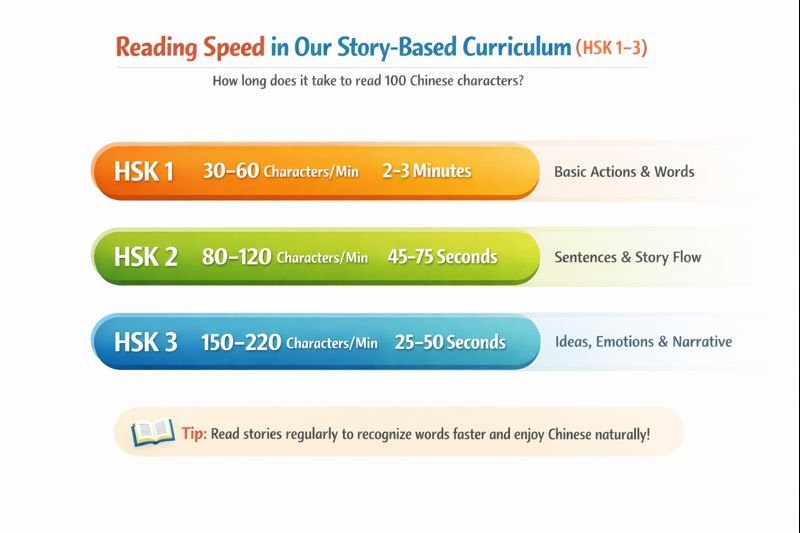
  • Reading Speed in Our Story-Based Curriculum

    Reading Speed in Our Story-Based Curriculum

    Reading Chinese through stories is different from studying vocabulary lists. Here, the goal is following meaning and enjoying the story, not translating every character. As you progress from HSK 1 to HSK 3, your reading speed and comprehension improve naturally.

    HSK 1: Getting Used to the Story Flow

    • Recognize characters and basic words in context
    • Typical speed: 30–60 characters/min
    • Time for 100 characters: 2–3 minutes

    HSK 2: Reading in Chunks

    • Recognize whole words and simple sentence patterns
    • Typical speed: 80–120 characters/min
    • Time for 100 characters: 45–75 seconds

    HSK 3: Following Ideas and Emotions

    • Recognize multi-character words automatically
    • Understand grammar without stopping
    • Infer meaning from context
    • Comfortable story reading: 150–220 characters/min
    • Time for 100 characters: 25–50 seconds

    Healthy Benchmarks Across Levels

    Level Speed (characters/min) Time for 100 Characters Focus
    HSK 1 30–60 2–3 min Basic actions & words
    HSK 2 80–120 45–75 sec Sentences & story flow
    HSK 3 150–220 25–50 sec Ideas, emotions & narrative

    Tip: Read stories regularly to recognize words faster and enjoy Chinese naturally!

  • 23hsk2w03d07 第三周的回顾 – Review of the Third Week

    23hsk2w03d07 第三周的回顾 – Review of the Third Week

    Eduardo and Sabina spend Sunday evening reflecting on a week of major milestones. From surviving their first exam to navigating the healthcare system and enjoying local leisure, they evaluate their rapid progress in Mandarin.

    爱德华多和萨宾娜在周日晚上回顾了具有重大里程碑意义的一周。从通过第一次考试到在医疗系统中沟通,再到享受当地休闲生活,他们评估了自己在普通话方面的飞速进步。

    LEVEL/WORDCOUNT: HSK 2 / 650 characters

    body { font-family: Arial, sans-serif; margin: 0; padding: 0; background-color: #fdfdfd; } .container { max-width: 900px; margin: 20px auto; padding: 0 15px; } .tab-group { margin: 25px 0; } .tab-buttons { display: flex; justify-content: space-around; flex-wrap: wrap; gap: 8px; margin-bottom: 10px; } .tab-buttons button { padding: 10px 18px; cursor: pointer; background-color: #ffe082; border: none; border-radius: 6px; font-weight: bold; } .tab-buttons button.active { background-color: #ffca28; } .tab-content { display: none; background-color: #fff8e1; padding: 20px; border-radius: 10px; box-shadow: 0 2px 6px rgba(0,0,0,0.1); } .tab-content.active { display: block; } h2 { color: #2e7d32; margin-top: 0; } textarea { width: 100%; padding: 10px; border-radius: 6px; border: 1px solid #ccc; } .vocab-tooltip { border-bottom: 1px dotted #333; cursor: help; font-weight: bold; color: #2e7d32; } .vocab-tooltip:hover::after { content: attr(data-tooltip); position: absolute; background: #333; color: white; padding: 5px 10px; border-radius: 4px; font-size: 12px; white-space: nowrap; transform: translate(-50%, -120%); } .answer-tooltip { border-bottom: 1px dotted #666; cursor: help; font-weight: bold; color: #1976d2; } .answer-tooltip:hover::after { content: attr(data-answer); position: absolute; background: #1976d2; color: white; padding: 8px 12px; border-radius: 4px; font-size: 13px; white-space: nowrap; transform: translate(-50%, -120%); }

    第三周的回顾

    今天是星期日,上海的天气非常晴朗。爱德华多和萨宾娜坐在操场边的长椅上。这一周对他们来说非常特别,因为他们完成了很多“第一次”。

    萨宾娜笑着说:“我最开心的是周三的汉语考试。虽然准备的时候很紧张,但是看到好成绩时,我觉得所有的努力都值得。在茶馆喝茶庆祝的时候,我发现自己能听懂服务员说的很多话了。”

    爱德华多点点头,虽然他这周生病了,但他觉得很有收获。他说:“去医院看医生让我学会了怎么描述身体不舒服。而且,我这周学会了用手机点外卖,这让我的生活变得更方便。最兴奋的是参加了足球比赛,我们队还了!”

    两个人都觉得,这一周他们的汉语水平提高得很快。现在他们去超市买东西时,不仅能看懂标签,还能和收银员简单聊天。萨宾娜觉得,他们已经慢慢习惯了上海的生活节奏

    太阳快要下山了,爱德华多拿出了他的手机,拍了一张美丽的夕阳。他们决定,下周要尝试去更远的地方旅游。带着这一周的信心,他们已经准备好迎接二月的新挑战了。

    Dì Sān Zhōu de Huígù

    Jīntiān shì xīngqīrì, Shànghǎi de tiānqì fēicháng qínglǎng. Àidéhuáduō hé Sàbīnnà zuò zài cāochǎng biān de chángyǐ shàng. Zhè yī zhōu duì tāmen lái shuō fēicháng tèbié, yīnwèi tāmen wánchéng le hěn duō “dì yī cì”.

    Sàbīnnà xiào zhe shuō: “Wǒ zuì kāixīn de shì zhōusān de Hànyǔ kǎoshì. Suīrán zhǔnbèi de shíhou hěn jǐnzhāng, dànshì kàndào hǎo chéngjì shí, wǒ juéde suǒyǒu de nǔlì dōu zhíde. Zài cháguǎn hē chá qìngzhù de shíhou, wǒ fāxiàn zìjǐ néng tīng dǒng fúwùyuán shuō de hěn duō huà le.”

    Àidéhuáduō diǎndiǎn tóu, suīrán tā zhè zhōu shēngbìng le, dànshì tā juéde hěn yǒu shōuhuò. Tā shuō: “Qù yīyuàn kàn yīshēng ràng wǒ xuéhuì le zěnme miáoshù shēntǐ bù shūfu. Érqiě, wǒ zhè zhōu xuéhuì le yòng shǒujī diàn wàimài, zhè ràng wǒ de shēnghuó biànde gèng fāngbiàn. Zuì xìngfèn de shì cānjiā le zúqiú bǐsài, wǒmen duì hái yíng le!”

    Liǎng gè rén dōu juéde, zhè yī zhōu tāmen de Hànyǔ shuǐpíng tígāo de hěn kuài. Xiànzài tāmen qù chāoshì mǎi dōngxi shí, bùjǐn néng kàn dǒng biāoqiān, hái néng hé shōuyínyuán jiǎndān liáotiān. Sàbīnnà juéde, tāmen yǐjīng mànmàn xíguàn le Shànghǎi de shēnghuó jiézòu.

    Tàiyáng kuàiyào xiàshān le, Àidéhuáduō ná chū le tā de shǒujī, pāi le yī zhāng měilì de xīyáng. Tāmen juédìng, xià zhōu yào chángshì qù gèng yuǎn de dìfang lǚyóu. Dài zhe zhè yī zhōu de xìnxīn, tāmen yǐjīng zhǔnbèi hǎo yíngjiē èryuè de xīn tiǎozhàn le.

    Review of the Third Week

    Today is Sunday, and the weather in Shanghai is very sunny. Eduardo and Sabina are sitting on a bench by the playground. This week has been very special for them because they completed many “firsts.”

    Sabina said with a smile: “The happiest thing for me was Wednesday’s Chinese exam. Although I was nervous during preparation, when I saw the good results, I felt all the effort was worth it. When celebrating with tea at the tea house, I found I could understand much of what the waiter said.”

    Eduardo nodded; although he got sick this week, he felt it was very productive. He said: “Going to the hospital to see the doctor taught me how to describe physical discomfort. Also, I learned to order takeout with my phone this week, which has made my life much more convenient. The most exciting part was participating in the soccer match—our team even won!”

    Both of them felt that their Chinese level improved very quickly this week. Now when they go to the supermarket to buy things, they can not only understand the labels but also chat simply with the cashier. Sabina feels that they have gradually become accustomed to the pace of life in Shanghai.

    The sun was about to set, and Eduardo took out his phone to take a picture of the beautiful sunset. They decided to try traveling to a further place next week. Carrying the confidence from this week, they are ready to welcome the new challenges of February.

    Help

    How to Use the Audio

    The audio is designed to help you improve your Mandarin Chinese listening skills and pronunciation.

    • Before reading: Listen to understand rhythm and intonation.
    • After reading: Listen again to compare pronunciation.

    Vocabulary

    Characters Pinyin English
    收获shōuhuògains/results/harvest
    值得zhídeto be worth it
    兴奋xīngfènexcited
    习惯xíguànto be used to/habit
    描述miáoshùto describe
    标签biāoqiānlabel/tag
    收银员shōuyínyuáncashier
    挑战tiǎozhànchallenge
    长椅chángyǐbench
    夕阳xīyángsunset

    Grammar

    The Degree Complement with “De” (得)
    In HSK 2, is essential for evaluating actions. Sabina notes their progress: 提高得很快.

    Indicating Change with “Le” (了)
    The particle at the end of a sentence indicates a new realization. Sabina uses it for her listening: 能听懂…了.

    Idiomatic Expressions

    第一次
    A fundamental phrase for discussing new experiences. Example: 完成了很多第一次.

    慢慢习惯
    Combined with a verb, it shows a gradual process of adaptation. Example: 慢慢习惯了.

    Cultural Insights

    Reflecting on progress is a valued part of the learning process in China. Students often set specific goals at the end of a month.

    Campus life in Shanghai often revolves around the 操场. It serves as a social hub where students meet to chat and enjoy the sunset.

    10 Questions

    1. 今天天气怎么样? (答案)
    2. 他们坐在哪里? (答案)
    3. 萨宾娜这周什么方面最开心? (答案)
    4. 萨宾娜在茶馆发现了什么? (答案)
    5. 爱德华多去医院学会了什么? (答案)
    6. 点外卖让爱德华多的生活怎么样? (答案)
    7. 爱德华多的足球队赢了吗? (答案)
    8. 他们在超市能和谁聊天? (答案)
    9. 爱德华多拍了什么? (答案)
    10. 他们下周想做什么? (答案)

    Multiple Choice

    1. 这一周对他们来说怎么样?(答案)
      a) 很累
      b) 非常特别
      c) 很无聊
    1. 他们准备好迎接什么了?(答案)
      a) 考试
      b) 寒假
      c) 二月的新挑战

    True or False

    1. 今天上海的天气不好。 (答案)
    2. 他们坐在长椅上。 (答案)
    3. 萨宾娜觉得努力不值得。 (答案)
    4. 爱德华多学会了点外卖。 (答案)
    5. 爱德华多的队输了。 (答案)
    6. 他们的汉语水平提高得很快。 (答案)
    7. 他们不能看懂超市的标签。 (答案)
    8. 萨宾娜还没有习惯上海的节奏。 (答案)
    9. 爱德华多拍了夕阳的照片。 (答案)
    10. 他们对未来没有信心。 (答案)

    Retell the Story

    请用你自己的话重写这个故事。

    document.querySelectorAll(‘.tab-group’).forEach(group => { const buttons = group.querySelectorAll(‘.tab-btn’); const contents = group.querySelectorAll(‘.tab-content’); buttons.forEach(button => { button.addEventListener(‘click’, () => { buttons.forEach(btn => btn.classList.remove(‘active’)); contents.forEach(content => content.classList.remove(‘active’)); button.classList.add(‘active’); document.getElementById(button.dataset.tab).classList.add(‘active’); }); }); });
  • 一周复习:生活小麻烦 – Weekly Review: Small Daily Problems

    一周复习:生活小麻烦 – Weekly Review: Small Daily Problems

    这一课复习没电、找钥匙、快递送错、买药、补办公交卡、电脑问题。 Today you review battery issues, lost keys, wrong deliveries, pharmacy visits, replacing a transit card, and a computer problem.

    LEVEL/WORDCOUNT: HSK2 / 690 Chinese characters (approx.)

    body { font-family: Arial, sans-serif; margin: 0; padding: 0; background-color: #fdfdfd; } .container { max-width: 900px; margin: 20px auto; padding: 0 15px; } .tab-group { margin: 25px 0; } .tab-buttons { display: flex; justify-content: space-around; flex-wrap: wrap; gap: 8px; margin-bottom: 10px; } .tab-buttons button { padding: 10px 18px; cursor: pointer; background-color: #ffe082; border: none; border-radius: 6px; font-weight: bold; } .tab-buttons button.active { background-color: #ffca28; } .tab-content { display: none; background-color: #fff8e1; padding: 20px; border-radius: 10px; box-shadow: 0 2px 6px rgba(0,0,0,0.1); } .tab-content.active { display: block; } h2 { color: #2e7d32; margin-top: 0; } textarea { width: 100%; padding: 10px; border-radius: 6px; border: 1px solid #ccc; } .vocab-tooltip { border-bottom: 1px dotted #333; cursor: help; font-weight: bold; color: #2e7d32; } .vocab-tooltip:hover::after { content: attr(data-tooltip); position: absolute; background: #333; color: white; padding: 5px 10px; border-radius: 4px; font-size: 12px; white-space: nowrap; transform: translate(-50%, -120%); } .answer-tooltip { border-bottom: 1px dotted #666; cursor: help; font-weight: bold; color: #1976d2; } .answer-tooltip:hover::after { content: attr(data-answer); position: absolute; background: #1976d2; color: white; padding: 8px 12px; border-radius: 4px; font-size: 13px; white-space: nowrap; transform: translate(-50%, -120%); }

    一周复习:生活小麻烦

    这周我遇到了很多小麻烦,但是也学会了怎么用中文解决。周一我在地铁站手机突然没电了, 我先去便利店问充电宝,可是都借完了。后来我不好意思地问旁边的人能不能借我充一会儿电, 手机一有电我就马上给朋友发消息。

    周二我回到家门口才发现找不到钥匙了。我在包里摸了半天,还是没有摸到,只好给朋友打电话, 问他现在方便吗。朋友来以后提醒我看看口袋,原来钥匙一直在里面。

    周三我在家等快递,快递员把箱子放在门口就走了。我一看名字不是我的,就给他打电话说是不是送错了。 他回来后说可能弄错了,把我的包裹放到别的楼了,后来又把正确的送来,我才放心。

    周四我有点儿不舒服:头疼、流鼻涕,还一直打喷嚏。虽然我没有发烧,但是我还是去药店买药。 店员说先多喝热水,再早点儿休息,还告诉我药一天吃三次,饭后吃。要是明天还不好,就去医院看看。

    周五我出门的时候才发现公交卡不见了。因为没有公交卡,所以我先用手机买地铁票。 下班后我去服务中心问怎么补办,工作人员让我先办新卡,旧卡找到了再来退。

    周六我想写作业,可是电脑怎么也打不开。我检查了线,换了插座,充了十分钟,还是不行。 没办法我只好问同学能不能帮忙,他视频教我按住一个按钮,再重新开机。电脑一下子就开了, 我终于把作业写完,也对同学说他帮了我一个大忙。

    我发现每次遇到问题,只要先冷静,再礼貌地问“请问…能不能…?”,就更容易得到帮助。 生活虽然会有小麻烦,但是用中文解决以后,我越来越有信心了。

    Yì Zhōu Fùxí: Shēnghuó Xiǎo Máfan (Pinyin)

    Zhè zhōu wǒ yùdào le hěn duō xiǎo máfan, dànshì yě xuéhuì le zěnme yòng Zhōngwén jiějué. Zhōu yī wǒ zài dìtiě zhàn shǒujī tūrán méi diàn le, wǒ xiān qù biànlìdiàn wèn chōngdiànbǎo, kěshì dōu jiè wán le. Hòulái wǒ bù hǎoyìsi de wèn pángbiān de rén néng bu néng jiè wǒ chōng yíhuǐr diàn, shǒujī yì yǒu diàn wǒ jiù mǎshàng gěi péngyou fā xiāoxi.

    Zhōu èr wǒ huí dào jiā ménkǒu cái fāxiàn zhǎo bù dào yàoshi le. Wǒ zài bāo lǐ mō le bàn tiān, háishì méiyǒu mō dào, zhǐhǎo gěi péngyou dǎ diànhuà, wèn tā xiànzài fāngbiàn ma. Péngyou lái yǐhòu tíxǐng wǒ kànkan kǒudài, yuánlái yàoshi yìzhí zài lǐmiàn.

    Zhōu sān wǒ zài jiā děng kuàidì, kuàidìyuán bǎ xiāngzi fàng zài ménkǒu jiù zǒu le. Wǒ yí kàn míngzi bú shì wǒ de, jiù gěi tā dǎ diànhuà shuō shì bù shì sòng cuò le. Tā huílái hòu shuō kěnéng nòng cuò le, bǎ wǒ de bāoguǒ fàng dào bié de lóu le, hòulái yòu bǎ zhèngquè de sònglái, wǒ cái fàngxīn.

    Zhōu sì wǒ yǒudiǎnr bú shūfu: tóuténg, liú bítì, hái yìzhí dǎ pēntì. Suīrán wǒ méiyǒu fāshāo, dànshì wǒ háishì qù yàodiàn mǎi yào. Diànyuán shuō xiān duō hē rè shuǐ, zài zǎo diǎnr xiūxi, hái gàosu wǒ yào yì tiān chī sān cì, fànhòu chī. Yàoshi míngtiān hái bù hǎo, jiù qù yīyuàn kànkan.

    Zhōu wǔ wǒ chūmén de shíhou cái fāxiàn gōngjiāo kǎ bùjiàn le. Yīnwèi méiyǒu gōngjiāo kǎ, suǒyǐ wǒ xiān yòng shǒujī mǎi dìtiě piào. Xiàbān hòu wǒ qù fúwù zhōngxīn wèn zěnme bǔbàn, gōngzuò rényuán ràng wǒ xiān bàn xīn kǎ, jiù kǎ zhǎodào le zài lái tuì.

    Zhōu liù wǒ xiǎng xiě zuòyè, kěshì diànnǎo zěnme yě dǎ bù kāi. Wǒ jiǎnchá le xiàn, huàn le chāzuò, chōng le shí fēnzhōng, háishì bù xíng. Méi bànfǎ wǒ zhǐhǎo wèn tóngxué néng bu néng bāngmáng, tā shìpín jiāo wǒ ànzhù yí gè ànniǔ, zài chóngxīn kāijī. Diànnǎo yíxiàzi jiù kāi le, wǒ zhōngyú bǎ zuòyè xiě wán, yě duì tóngxué shuō tā bāng le wǒ yí gè dà máng.

    Wǒ fāxiàn měi cì yùdào wèntí, zhǐyào xiān lěngjìng, zài lǐmào de wèn “qǐngwèn…néng bu néng…?”, jiù gèng róngyì dédào bāngzhù. Shēnghuó suīrán huì yǒu xiǎo máfan, dànshì yòng Zhōngwén jiějué yǐhòu, wǒ yuèláiyuè yǒu xìnxīn le.

    Weekly Review: Small Daily Problems

    This week I ran into many small problems, but I also learned how to solve them in Chinese. On Monday my phone died at the subway station, and as soon as it had power I messaged my friend. On Tuesday I couldn’t find my keys and only then realized they were in my pocket.

    On Wednesday the courier delivered the wrong package, so I called to explain that the name wasn’t mine. On Thursday I didn’t feel well, so I went to a pharmacy and asked how to take the medicine. On Friday my transit card was missing, so I asked the service center how to replace it.

    On Saturday my computer wouldn’t turn on, so I asked a classmate for help and finally finished my homework. I realized that every time a problem happens, staying calm and asking politely makes it easier to get help.[1][2]

    Help

    How to Use the Audio

    The audio is designed to help you improve your Mandarin Chinese listening skills and pronunciation. You can use it in two ways:

    • Before reading: Listen to understand rhythm, intonation, and natural speech.
    • After reading: Listen again to compare pronunciation and improve fluency.

    Vocabulary (Review)

    CharactersPinyinEnglish
    充电宝chōngdiànbǎopower bank
    钥匙yàoshikeys
    快递kuàidìdelivery
    药店yàodiànpharmacy
    补办bǔbànreplace/re-issue
    插座chāzuòoutlet
    按住ànzhùpress and hold
    冷静lěngjìngcalm
    礼貌lǐmàopolite
    信心xìnxīnconfidence

    Grammar (Review)

    1. 一…就… — immediate sequence (as soon as… then…)
      手机一有电,我就发消息。
    2. [3]
    3. 每次…都… — “every time… always…”
      每次遇到问题,我都先冷静。
    4. [1]
    5. 虽然…但是… — contrast (although… but…)
      虽然没发烧,但是不舒服。
    6. [4]
    7. 因为…所以… — cause and effect
      因为没卡,所以买地铁票。
    8. [5]
    9. 请问 / 能不能… — polite requesting
      请问能不能帮我看看?
    10. [2]

    Idiomatic Expressions

    不好意思 — polite opener before asking for help.

    麻烦你了 — “sorry to trouble you,” polite thanks.

    没办法 — “no choice,” when you must ask for help.

    原来… — “turns out…,” when you realize something.

    帮了我一个大忙 — “you helped me a lot.”

    Cultural Insights

    Many everyday problems are solved through short service conversations, and politeness is usually shown with “不好意思 / 请问” plus an indirect request like “能不能…”.[2]

    In daily speech, “每次…都…” is often used to talk about repeated experiences and habits, especially when giving advice.[1]

    10 Questions

    1. 周一他遇到什么问题? (答案)
    2. 手机一有电他就做什么? (答案)
    3. 周二他找不到什么? (答案)
    4. 钥匙原来在哪里? (答案)
    5. 周三快递怎么了? (答案)
    6. 周四他去哪儿买药? (答案)
    7. 药一天吃几次? (答案)
    8. 周五他丢了什么卡? (答案)
    9. 周六电脑怎么了? (答案)
    10. 他学到什么方法? (答案)

    Multiple Choice

    1. “每次…都…”表示: (答案)
      a) 只有一次
      b) 每一次都一样
      c) 以后才做
    2. 他周三打电话是因为: (答案)
      a) 快递送错了
      b) 手机没电
      c) 想吃饭
    3. 店员说先…再…: (答案)
      a) 买票再出门
      b) 睡觉再吃饭
      c) 喝热水再休息
    4. 因为没公交卡,所以他: (答案)
      a) 不上班
      b) 买地铁票
      c) 去医院
    5. 同学帮他的方法是: (答案)
      a) 视频教他
      b) 给他钱
      c) 送他回家

    True or False

    1. 这周他只遇到一个问题。 (答案)
    2. 周二钥匙一直在口袋里。 (答案)
    3. 周四他发烧了。 (答案)
    4. 周五他去服务中心补办新卡。 (答案)
    5. 他觉得用中文解决问题越来越有信心。 (答案)

    Retell the Week

    请用你自己的话复述这一周发生的事情。

    Hints: 每天一个小问题 / 不好意思请问能不能 / 先…再… / 一…就… / 每次…都… / 虽然…但是…

    document.querySelectorAll(‘.tab-group’).forEach(group => { const buttons = group.querySelectorAll(‘.tab-btn’); const contents = group.querySelectorAll(‘.tab-content’); buttons.forEach(button => { button.addEventListener(‘click’, () => { buttons.forEach(btn => btn.classList.remove(‘active’)); contents.forEach(content => content.classList.remove(‘active’)); button.classList.add(‘active’); document.getElementById(button.dataset.tab).classList.add(‘active’); }); }); });
  • 这家比那家近 – This Place Is Closer Than That One

    这家比那家近 – This Place Is Closer Than That One

    今天练习比较远近、价格、和“比”字句。 Today you practice comparing distance, price, and using comparison sentences with 比.

    LEVEL/WORDCOUNT: HSK2 / 460 Chinese characters (approx.)

    body { font-family: Arial, sans-serif; margin: 0; padding: 0; background-color: #fdfdfd; } .container { max-width: 900px; margin: 20px auto; padding: 0 15px; } .tab-group { margin: 25px 0; } .tab-buttons { display: flex; justify-content: space-around; flex-wrap: wrap; gap: 8px; margin-bottom: 10px; } .tab-buttons button { padding: 10px 18px; cursor: pointer; background-color: #ffe082; border: none; border-radius: 6px; font-weight: bold; } .tab-buttons button.active { background-color: #ffca28; } .tab-content { display: none; background-color: #fff8e1; padding: 20px; border-radius: 10px; box-shadow: 0 2px 6px rgba(0,0,0,0.1); } .tab-content.active { display: block; } h2 { color: #2e7d32; margin-top: 0; } textarea { width: 100%; padding: 10px; border-radius: 6px; border: 1px solid #ccc; } .vocab-tooltip { border-bottom: 1px dotted #333; cursor: help; font-weight: bold; color: #2e7d32; } .vocab-tooltip:hover::after { content: attr(data-tooltip); position: absolute; background: #333; color: white; padding: 5px 10px; border-radius: 4px; font-size: 12px; white-space: nowrap; transform: translate(-50%, -120%); } .answer-tooltip { border-bottom: 1px dotted #666; cursor: help; font-weight: bold; color: #1976d2; } .answer-tooltip:hover::after { content: attr(data-answer); position: absolute; background: #1976d2; color: white; padding: 8px 12px; border-radius: 4px; font-size: 13px; white-space: nowrap; transform: translate(-50%, -120%); }

    这家比那家近

    周末我和朋友想出去吃饭。我们在手机上看了两个 restaurant,一个在地铁站旁边,一个在商场那边。 朋友问我:“你觉得去哪一家更好?”

    我看了看地图,说:“这家离地铁站很近,那家离地铁站比较远。对我们来说,这家比那家方便。” 朋友又问:“那价格呢?哪一家便宜?”

    我打开菜单一看,说:“这家的菜比那家的菜便宜一点儿,而且选择也多。 虽然那家环境比较漂亮,但是离我们家太远了。”

    最后我们决定先去地铁站旁边这家吃。走路只要五分钟,比坐车去商场快多了。 吃完饭以后,我们都觉得今天的选择不错,下次还想来这家。

    Zhè Jiā Bǐ Nà Jiā Jìn (Pinyin)

    Zhōumò wǒ hé péngyou xiǎng chūqù chīfàn. Wǒmen zài shǒujī shàng kàn le liǎng gè restaurant, yí gè zài dìtiě zhàn pángbiān, yí gè zài shāngchǎng nàbiān. Péngyou wèn wǒ: “Nǐ juéde qù nǎ yì jiā gèng hǎo?”

    Wǒ kàn le kàn dìtú, shuō: “Zhè jiā lí dìtiě zhàn hěn jìn, nà jiā lí dìtiě zhàn bǐjiào yuǎn. Duì wǒmen láishuō, zhè jiā bǐ nà jiā fāngbiàn.” Péngyou yòu wèn: “Nà jiàgé ne? Nǎ yì jiā piányi?”

    Wǒ dǎkāi càidān yí kàn, shuō: “Zhè jiā de cài bǐ nà jiā de cài piányi yìdiǎnr, érqiě xuǎnzé yě duō. Suīrán nà jiā huánjìng bǐjiào piàoliang, dànshì lí wǒmen jiā tài yuǎn le.”

    Zuìhòu wǒmen juédìng xiān qù dìtiě zhàn pángbiān zhè jiā chī. Zǒulù zhǐ yào wǔ fēnzhōng, bǐ zuò chē qù shāngchǎng kuài duō le. Chī wán fàn yǐhòu, wǒmen dōu juéde jīntiān de xuǎnzé bú cuò, xià cì hái xiǎng lái zhè jiā.

    This Place Is Closer Than That One

    On the weekend my friend and I wanted to eat out. We checked two restaurants on the phone: one was next to the subway station, the other near a shopping mall. My friend asked which one I thought was better.

    I looked at the map and said the first one was closer to the station and more convenient for us. Then my friend asked which one was cheaper, so I opened the menu to compare prices.

    I saw that the food at the closer restaurant was a bit cheaper and there were more choices. Although the other place looked nicer, it was too far from our home, so we chose the closer one.

    Walking there only took five minutes, much faster than taking transport to the mall, and we both felt happy with the decision and wanted to come back next time.

    Help

    How to Use the Audio

    The audio is designed to help you improve your Mandarin Chinese listening skills and pronunciation.

    • Before reading: Listen to understand rhythm, intonation, and natural speech.
    • After reading: Listen again to compare pronunciation and improve fluency.

    Vocabulary

    Characters Pinyin English
    这家 / 那家zhè jiā / nà jiāthis place / that place (shop, restaurant)
    away from (distance)
    地铁站dìtiě zhànsubway station
    商场shāngchǎngshopping mall
    方便fāngbiànconvenient
    便宜piányicheap; inexpensive
    环境huánjìngenvironment; atmosphere
    选择xuǎnzéchoice; selection
    地图dìtúmap
    走路zǒulùwalk (on foot)

    Grammar

    [A 比 B + Adj. (A is more … than B)]
    Use 比 to compare two things: A 比 B + adjective. This is a core HSK2 pattern for comparisons. [web:41][web:281]
    Example: 这家比那家近。 (This place is closer than that one.)

    [比较 + Adj. (relatively / quite …)]
    比较 before an adjective means “relatively / quite,” and is softer than a direct 比-sentence. [web:281][web:284]
    Example: 那家离地铁站比较远。 (That one is relatively far from the station.)

    [A 比 B + Adj. + 一点儿 (a bit more …)]
    Add 一点儿 to show the difference is small or polite. [web:41]
    Example: 这家的菜比那家的菜便宜一点儿。 (The food here is a bit cheaper than there.)

    Idiomatic Expressions

    对…来说
    Means “for … / as far as … is concerned.”
    Example: 对我们来说,这家更方便。

    …不错
    A common way to say “pretty good.”
    Example: 我们觉得今天的选择不错。

    下次还想…
    Shows you want to repeat the experience.
    Example: 下次还想来这家。

    Cultural Insights

    When choosing restaurants in Chinese cities, people often compare distance from the subway, price, and 环境 (environment), using 比 and 比较 to discuss which is better or more convenient. [web:41][web:281]

    Saying “这家比那家方便” or “那家比较远” is a very natural, short way to express preferences without sounding too strong or critical.

    10 Questions

    1. 周末他们想做什么? (答案)
    2. 两个restaurant分别在哪里? (答案)
    3. 谁问“去哪一家更好”? (答案)
    4. 这家和那家,哪一家离地铁站近? (答案)
    5. 对他们来说,哪一家更方便? (答案)
    6. 这家的菜跟那家的菜比,怎么样? (答案)
    7. 哪一家环境比较漂亮? (答案)
    8. 他们最后决定去哪一家? (答案)
    9. 走路去这家要多久? (答案)
    10. 吃完饭以后,他们怎么觉得? (答案)

    Multiple Choice

    1. 这家离地铁站: (答案)
      a) 比那家近
      b) 比那家远
      c) 没有地铁
    2. 那家离地铁站: (答案)
      a) 很近
      b) 比较远
      c) 在楼上
    3. 这家的菜: (答案)
      a) 贵得多
      b) 一样贵
      c) 比那家便宜一点儿
    4. 虽然那家环境比较漂亮,但是: (答案)
      a) 离家太远了
      b) 没有菜
      c) 没有人
    5. 他们最后觉得: (答案)
      a) 不想再去
      b) 今天的选择不错
      c) 还没吃饭

    True or False

    1. 两个restaurant都在商场里。 (答案)
    2. 这家比那家离地铁站近。 (答案)
    3. 这家的菜比那家贵很多。 (答案)
    4. 那家的环境比较漂亮。 (答案)
    5. 他们最后决定去地铁站旁边的那家。 (答案)

    Retell the Story

    请用你自己的话重写这个故事。

    Hints: 周末想吃饭 / 两家restaurant / 这家比那家近 / 哪家便宜 / 虽然…但是… / 最后决定 / 下次还想来

    document.querySelectorAll(‘.tab-group’).forEach(group => { const buttons = group.querySelectorAll(‘.tab-btn’); const contents = group.querySelectorAll(‘.tab-content’); buttons.forEach(button => { button.addEventListener(‘click’, () => { buttons.forEach(btn => btn.classList.remove(‘active’)); contents.forEach(content => content.classList.remove(‘active’)); button.classList.add(‘active’); document.getElementById(button.dataset.tab).classList.add(‘active’); }); }); });
  • 门开着呢 – The Door Is Left Open

    门开着呢 – The Door Is Left Open

    今天练习用“着”描述状态、用“还…呢”表示还没结束、和提醒别人注意安全。 Today you practice using 着 for ongoing states, 还…呢 for “not yet finished,” and gently reminding others about safety.

    LEVEL/WORDCOUNT: HSK2 / 462 Chinese characters (approx.)

    body { font-family: Arial, sans-serif; margin: 0; padding: 0; background-color: #fdfdfd; } .container { max-width: 900px; margin: 20px auto; padding: 0 15px; } .tab-group { margin: 25px 0; } .tab-buttons { display: flex; justify-content: space-around; flex-wrap: wrap; gap: 8px; margin-bottom: 10px; } .tab-buttons button { padding: 10px 18px; cursor: pointer; background-color: #ffe082; border: none; border-radius: 6px; font-weight: bold; } .tab-buttons button.active { background-color: #ffca28; } .tab-content { display: none; background-color: #fff8e1; padding: 20px; border-radius: 10px; box-shadow: 0 2px 6px rgba(0,0,0,0.1); } .tab-content.active { display: block; } h2 { color: #2e7d32; margin-top: 0; } textarea { width: 100%; padding: 10px; border-radius: 6px; border: 1px solid #ccc; } .vocab-tooltip { border-bottom: 1px dotted #333; cursor: help; font-weight: bold; color: #2e7d32; } .vocab-tooltip:hover::after { content: attr(data-tooltip); position: absolute; background: #333; color: white; padding: 5px 10px; border-radius: 4px; font-size: 12px; white-space: nowrap; transform: translate(-50%, -120%); } .answer-tooltip { border-bottom: 1px dotted #666; cursor: help; font-weight: bold; color: #1976d2; } .answer-tooltip:hover::after { content: attr(data-answer); position: absolute; background: #1976d2; color: white; padding: 8px 12px; border-radius: 4px; font-size: 13px; white-space: nowrap; transform: translate(-50%, -120%); }

    门开着呢

    下班以后,我和同事一起离开办公室。走到门口的时候,我回头看了一眼,发现办公室的灯还开着, 门也开着呢。我对同事说:“等一下,门还开着,我们先回去看看。”

    进去以后,我看到桌子上还放着一台电脑,屏幕亮着,同事的外套也挂在椅子上。 我问:“是不是还有人没走?电脑怎么还开着?”

    正说着,另一位同事从走廊那边走回来,手里拿着咖啡。他说:“我还在加班呢,只是刚才出去买东西。 你们先走吧,我晚一点儿关灯、关门。”

    我笑着说:“好,那我们走了。你记得关好门,电脑不要一直开着,安全也重要。” 出了门以后,我又看了一下,办公室的门关得好好的,我才放心回家。

    Mén Kāizhe Ne (Pinyin)

    Xiàbān yǐhòu, wǒ hé tóngshì yìqǐ líkāi bàngōngshì. Zǒu dào ménkǒu de shíhou, wǒ huítóu kàn le yí yǎn, fāxiàn bàngōngshì de dēng hái kāizhe, mén yě kāizhe ne. Wǒ duì tóngshì shuō: “Děng yíxià, mén hái kāizhe, wǒmen xiān huíqù kànkan.”

    Jìnqù yǐhòu, wǒ kàndào zhuōzi shàng hái fàngzhe yì tái diànnǎo, píngmù liàngzhe, tóngshì de wàitào yě guàzhe zài yǐzi shàng. Wǒ wèn: “Shì bú shì hái yǒu rén méi zǒu? Diànnǎo zěnme hái kāizhe?”

    Zhèng shuōzhe, lìng yì wèi tóngshì cóng zǒuláng nàbiān zǒu huílái, shǒu lǐ názhe kāfēi. Tā shuō: “Wǒ hái zài jiābān ne, zhǐshì gāngcái chūqù mǎi dōngxi. Nǐmen xiān zǒu ba, wǒ wǎn yìdiǎnr guān dēng, guān mén.”

    Wǒ xiàozhe shuō: “Hǎo, nà wǒmen zǒu le. Nǐ jìde guān hǎo mén, diànnǎo búyào yìzhí kāizhe, ānquán yě zhòngyào.” Chū le mén yǐhòu, wǒ yòu kàn le yíxià, bàngōngshì de mén guān de hǎohǎo de, wǒ cái fàngxīn huíjiā.

    The Door Is Left Open

    After work my colleague and I were leaving the office. At the door I looked back and noticed that the lights were still on and the door was still open, so we went back to check.

    Inside, a computer was still on and a colleague’s coat was hanging on the chair, so I wondered if someone was still there. Just then another colleague came back with coffee and said he was still working overtime and had only gone out to buy something.

    He told us to go ahead and said he would turn off the lights and close the door later. I reminded him to close the door properly and not leave the computer on for too long because of safety, and only felt relaxed once I saw the office door closed behind us.

    Help

    How to Use the Audio

    The audio is designed to help you improve your Mandarin Chinese listening skills and pronunciation.

    • Before reading: Listen to understand rhythm, intonation, and natural speech.
    • After reading: Listen again to compare pronunciation and improve fluency.

    Vocabulary

    Characters Pinyin English
    办公室bàngōngshìoffice
    dēnglight; lamp
    开着kāizhebe on / be open
    挂着guàzhebe hanging
    屏幕píngmùscreen
    走廊zǒulángcorridor; hallway
    加班jiābānwork overtime
    关灯 / 关门guān dēng / guān ménturn off lights / close door
    安全ānquánsafety
    放心fàngxīnfeel at ease; relieved

    Grammar

    [Verb + 着: ongoing state]
    着 after a verb often shows a continuous state, like doors being open or lights being on. [web:41][web:297][web:101]
    Examples: 门开着呢。 (The door is open.) 外套挂着。 (The coat is hanging.)

    [还 + Verb + 着 / 还开着]
    还 with 着 highlights that the state is still continuing, often when it “should” have finished. [web:41][web:299]
    Example: 灯还开着,电脑也还开着。 (The light is still on, and the computer is still on.)

    [还 … 呢 (still …, not over yet)]
    还…呢 can show “still doing / still happening,” often in spoken Chinese. [web:41]
    Example: 我还在加班呢。 (I’m still working overtime.)

    Idiomatic Expressions

    等一下
    “Wait a moment,” used to stop someone briefly.

    记得…
    Means “remember to… / don’t forget to…”.
    Example: 你记得关好门。

    …才放心
    “Only then feel relieved.”
    Example: 看见门关好,我才放心。

    Cultural Insights

    In office settings it is common to remind coworkers politely about lights, doors, and computers, using structures like “门还开着呢” or “记得关好门” instead of direct commands.

    The pattern “我还在加班呢” is a very natural way to explain that work is still going on and to show why someone is still in the office late. [web:41]

    10 Questions

    1. 他们什么时候离开办公室? (答案)
    2. 在门口,我发现了什么? (答案)
    3. 为什么我说“等一下,我们先回去看看”? (答案)
    4. 进去以后,桌子上和椅子上分别有什么? (答案)
    5. 那位同事从哪里走回来,手里拿着什么? (答案)
    6. 他在做什么工作? (答案)
    7. 谁说要晚一点儿关灯、关门? (答案)
    8. 我提醒他注意什么? (答案)
    9. 出门以后,我又做了什么? (答案)
    10. 什么时候我才放心回家? (答案)

    Multiple Choice

    1. “门开着呢”里的“着”表示: (答案)
      a) 过去已经关了
      b) 门现在是开着的状态
      c) 以后要打开
    2. “灯还开着”里的“还”表示: (答案)
      a) 一定不会关
      b) 已经关了
      c) 还没关,状态在继续
    3. 同事说“我还在加班呢”,意思是: (答案)
      a) 现在还在工作
      b) 今天不用工作
      c) 明天才工作
    4. 最后是谁关灯、关门? (答案)
      a) 我
      b) 加班的同事
      c) 服务员
    5. 我看到什么以后才放心? (答案)
      a) 门关得好好的
      b) 灯都打开
      c) 电脑一直开着

    True or False

    1. 下班以后,他们马上离开,没有回头看。 (答案)
    2. 我发现办公室的灯还开着,门也开着。 (答案)
    3. 办公室里什么东西都关了,没有人在加班。 (答案)
    4. 那位同事只是出去买东西,很快就回来了。 (答案)
    5. 最后我确认门关好以后才放心回家。 (答案)

    Retell the Story

    请用你自己的话重写这个故事。

    Hints: 下班离开办公室 / 发现灯还开着门也开着 / 回去看看 / 桌子上放着电脑、椅子上挂着外套 / 我还在加班呢 / 记得关好门 / 我才放心

    document.querySelectorAll(‘.tab-group’).forEach(group => { const buttons = group.querySelectorAll(‘.tab-btn’); const contents = group.querySelectorAll(‘.tab-content’); buttons.forEach(button => { button.addEventListener(‘click’, () => { buttons.forEach(btn => btn.classList.remove(‘active’)); contents.forEach(content => content.classList.remove(‘active’)); button.classList.add(‘active’); document.getElementById(button.dataset.tab).classList.add(‘active’); }); }); });
  • 我们先看看吧 – Let’s Take a Look First

    我们先看看吧 – Let’s Take a Look First

    今天练习用“看看”和“试试”表示“试一试”,以及用“…吧”提出建议。 Today you practice using 看看 and 试试 for “have a look” or “try,” and making suggestions with …吧.

    LEVEL/WORDCOUNT: HSK2 / 465 Chinese characters (approx.)

    body { font-family: Arial, sans-serif; margin: 0; padding: 0; background-color: #fdfdfd; } .container { max-width: 900px; margin: 20px auto; padding: 0 15px; } .tab-group { margin: 25px 0; } .tab-buttons { display: flex; justify-content: space-around; flex-wrap: wrap; gap: 8px; margin-bottom: 10px; } .tab-buttons button { padding: 10px 18px; cursor: pointer; background-color: #ffe082; border: none; border-radius: 6px; font-weight: bold; } .tab-buttons button.active { background-color: #ffca28; } .tab-content { display: none; background-color: #fff8e1; padding: 20px; border-radius: 10px; box-shadow: 0 2px 6px rgba(0,0,0,0.1); } .tab-content.active { display: block; } h2 { color: #2e7d32; margin-top: 0; } textarea { width: 100%; padding: 10px; border-radius: 6px; border: 1px solid #ccc; } .vocab-tooltip { border-bottom: 1px dotted #333; cursor: help; font-weight: bold; color: #2e7d32; } .vocab-tooltip:hover::after { content: attr(data-tooltip); position: absolute; background: #333; color: white; padding: 5px 10px; border-radius: 4px; font-size: 12px; white-space: nowrap; transform: translate(-50%, -120%); } .answer-tooltip { border-bottom: 1px dotted #666; cursor: help; font-weight: bold; color: #1976d2; } .answer-tooltip:hover::after { content: attr(data-answer); position: absolute; background: #1976d2; color: white; padding: 8px 12px; border-radius: 4px; font-size: 13px; white-space: nowrap; transform: translate(-50%, -120%); }

    我们先看看吧

    周末我和朋友去逛街。我们先去了一家服装店,店员问:“你们想买什么?” 我说:“我们先看看,不着急买。”

    朋友看到一件红色的外套,问我:“你觉得怎么样?我试试可以吗?” 我说:“当然可以,你试试看,我看看颜色合不合适。”

    朋友试了以后,觉得有点儿大。我又说:“你再试试那件蓝色的,我们比较一下。” 朋友试了蓝色的以后,说:“还是这件红色的比较好看,我们买这件吧。”

    买完衣服以后,店员问:“要不要试试鞋子?我们新到了几双,质量都不错。” 我们说:“不用了,谢谢。我们先看看,下次再来试试。”

    Wǒmen Xiān Kànkan Ba (Pinyin)

    Zhōumò wǒ hé péngyou qù guàngjiē. Wǒmen xiān qù le yì jiā fúzhuāng diàn, diànyuán wèn: “Nǐmen xiǎng mǎi shénme?” Wǒ shuō: “Wǒmen xiān kànkan, bù zhāojí mǎi.”

    Péngyou kàn dào yí jiàn hóngsè de wàitào, wèn wǒ: “Nǐ juéde zěnmeyàng? Wǒ shìshi kěyǐ ma?” Wǒ shuō: “Dāngrán kěyǐ, nǐ shìshi kàn, wǒ kànkan yánsè héshì bù héshì.”

    Péngyou shì le yǐhòu, juéde yǒudiǎnr dà. Wǒ yòu shuō: “Nǐ zài shìshi nà jiàn lánsè de, wǒmen bǐjiào yíxià.” Péngyou shì le lánsè de yǐhòu, shuō: “Hái shì zhè jiàn hóngsè de bǐjiào hǎokàn, wǒmen mǎi zhè jiàn ba.”

    Mǎi wán yīfu yǐhòu, diànyuán wèn: “Yào bú yào shìshi xiézi? Wǒmen xīn dào le jǐ shuāng, zhìliàng dōu bùcuò.” Wǒmen shuō: “Búyòng le, xièxie. Wǒmen xiān kànkan, xiàcì zài lái shìshi.”

    Let’s Take a Look First

    On the weekend my friend and I went shopping. We went to a clothing store, and the clerk asked what we wanted to buy. I said we wanted to look around first and weren’t in a hurry to buy.

    My friend saw a red coat and asked me what I thought. He asked if he could try it on, and I said of course, go ahead and try it, and I’ll check if the color suits him.

    After trying it on, he thought it was a bit big. I suggested trying the blue one and comparing. After trying the blue one, he said the red one looked better, so we decided to buy the red one.

    After buying the clothes, the clerk asked if we wanted to try on some shoes, saying they had just received several pairs, all good quality. We said thanks, but we would just look around for now and try shoes next time.

    Help

    How to Use the Audio

    The audio is designed to help you improve your Mandarin Chinese listening skills and pronunciation.

    • Before reading: Listen to understand rhythm, intonation, and natural speech.
    • After reading: Listen again to compare pronunciation and improve fluency.

    Vocabulary

    Characters Pinyin English
    逛街guàngjiēgo window shopping
    服装店fúzhuāng diànclothing store
    外套wàitàocoat
    试试shìshitry (on)
    合适héshìsuitable
    比较bǐjiàocompare
    鞋子xiézishoes
    质量zhìliàngquality
    看看kànkanhave a look
    先…再…xiān…zài…first…then…

    Grammar

    [Verb + Verb (AA reduplication)]
    Reduplicating a verb (e.g., 看看, 试试) means “do it briefly” or “try it out.” This is a common HSK2 pattern. [web:309][web:310]
    Example: 我们先看看。 (Let’s take a look first.)

    [Verb + 一下 (verb yixia)]
    Verb + 一下 means “do it for a bit” or “try briefly.” [web:41]
    Example: 你试试看。 (Try it out.)

    […吧 (making suggestions)]
    Adding 吧 at the end of a sentence makes it sound like a suggestion or a gentle proposal. [web:315][web:314]
    Example: 我们买这件吧。 (Let’s buy this one.)

    Idiomatic Expressions

    不着急买
    “Don’t hurry to buy,” very common when shopping.

    试试看
    “Have a try,” used to encourage someone to try something.

    比较一下
    “Compare (a little),” useful for shopping or decision-making.

    Cultural Insights

    In Chinese shopping culture, it’s common to say “我们先看看” (let’s look around first) before buying anything. Reduplicated verbs like 看看 and 试试 are used to sound casual and friendly. [web:309]

    Adding 吧 at the end of a sentence (e.g., “买这件吧”) is a gentle way to suggest a decision, making group shopping conversations smoother and less pushy. [web:315]

    10 Questions

    1. 周末他们去逛街了吗? (答案)
    2. 他们先去了一家什么店? (答案)
    3. 他们一开始想买吗? (答案)
    4. 朋友想试试什么? (答案)
    5. 朋友试了以后觉得怎么样? (答案)
    6. 我建议他再试试什么? (答案)
    7. 最后他们决定买哪一件? (答案)
    8. 店员问要不要试试什么? (答案)
    9. 他们最后想买鞋子吗? (答案)
    10. 他们用“试试”和“看看”来表示什么? (答案)

    Multiple Choice

    1. “我们先看看”里的“看看”表示: (答案)
      a) 先看一看,不着急买
      b) 一定要买
      c) 不想看
    2. 朋友试了红色的外套以后觉得: (答案)
      a) 很合适
      b) 有点儿大
      c) 很小
    3. 我建议他再试试: (答案)
      a) 红色的
      b) 黑色的
      c) 蓝色的
    4. “我们买这件吧”里的“吧”表示: (答案)
      a) 提出建议
      b) 命令
      c) 拒绝
    5. 店员说鞋子: (答案)
      a) 都很贵
      b) 质量都不错
      c) 都不好

    True or False

    1. 他们一开始就想买衣服。 (答案)
    2. 朋友试了红色的外套,觉得合适。 (答案)
    3. 最后他们买了红色的外套。 (答案)
    4. 店员建议他们试试鞋子。 (答案)
    5. 他们最后买了鞋子。 (答案)

    Retell the Story

    请用你自己的话重写这个故事。

    Hints: 逛街 / 先看看 / 试试看 / 有点儿大 / 比较一下 / 买这件吧 / 下次再来试试

    document.querySelectorAll(‘.tab-group’).forEach(group => { const buttons = group.querySelectorAll(‘.tab-btn’); const contents = group.querySelectorAll(‘.tab-content’); buttons.forEach(button => { button.addEventListener(‘click’, () => { buttons.forEach(btn => btn.classList.remove(‘active’)); contents.forEach(content => content.classList.remove(‘active’)); button.classList.add(‘active’); document.getElementById(button.dataset.tab).classList.add(‘active’); }); }); });
  • 一周复习:选择和计划 – Weekly Review: Choices & Plans

    一周复习:选择和计划 – Weekly Review: Choices & Plans

    今天复习比较、选择、经验、状态、提醒、建议,以及“…吧”和“先…再…”。 Today you review comparing, choosing, experiences, ongoing states, reminders, suggestions, and “…吧” and “先…再…”.

    LEVEL/WORDCOUNT: HSK2 / 685 Chinese characters (approx.)

    body { font-family: Arial, sans-serif; margin: 0; padding: 0; background-color: #fdfdfd; } .container { max-width: 900px; margin: 20px auto; padding: 0 15px; } .tab-group { margin: 25px 0; } .tab-buttons { display: flex; justify-content: space-around; flex-wrap: wrap; gap: 8px; margin-bottom: 10px; } .tab-buttons button { padding: 10px 18px; cursor: pointer; background-color: #ffe082; border: none; border-radius: 6px; font-weight: bold; } .tab-buttons button.active { background-color: #ffca28; } .tab-content { display: none; background-color: #fff8e1; padding: 20px; border-radius: 10px; box-shadow: 0 2px 6px rgba(0,0,0,0.1); } .tab-content.active { display: block; } h2 { color: #2e7d32; margin-top: 0; } textarea { width: 100%; padding: 10px; border-radius: 6px; border: 1px solid #ccc; } .vocab-tooltip { border-bottom: 1px dotted #333; cursor: help; font-weight: bold; color: #2e7d32; } .vocab-tooltip:hover::after { content: attr(data-tooltip); position: absolute; background: #333; color: white; padding: 5px 10px; border-radius: 4px; font-size: 12px; white-space: nowrap; transform: translate(-50%, -120%); } .answer-tooltip { border-bottom: 1px dotted #666; cursor: help; font-weight: bold; color: #1976d2; } .answer-tooltip:hover::after { content: attr(data-answer); position: absolute; background: #1976d2; color: white; padding: 8px 12px; border-radius: 4px; font-size: 13px; white-space: nowrap; transform: translate(-50%, -120%); }

    一周复习:选择和计划

    这周我和朋友做了很多选择和计划。周一我们先去了一家餐厅,比较了两家的价格和距离。 这家比那家便宜,而且离地铁站近,所以我们选择了这家。

    周二我们想喝饮料,朋友问我:“你想喝茶还是咖啡?”我最近晚上睡得不太好,所以选择了热茶。 朋友说他有点儿累,还是喝咖啡吧。

    周三我们聊起周末的计划。朋友问:“你去过河边那个公园吗?”我告诉他我去过好几次, 春天花多,夏天晚上散步的人也很多。他听了以后说:“听起来不错,下次你有空的时候,我们一起去吧。”

    周四我们离开办公室的时候,发现门还开着,灯也开着呢。我们提醒同事:“记得关好门,电脑不要一直开着,安全也重要。” 同事说:“我还在加班呢,晚一点儿关灯、关门。”

    周五我提醒朋友:“别忘了带伞,要是下雨就麻烦了。”朋友笑着说:“谢谢,我记住了。”

    周六我们去逛街,先看看,不着急买。朋友试了红色的外套,觉得有点儿大,又试了蓝色的。 最后他觉得红色的比较好看,我们买这件吧。店员问要不要试试鞋子,我们说:“不用了,谢谢。我们先看看,下次再来试试。”

    这周我学到,每次遇到选择,只要先冷静,再礼貌地问“请问…能不能…?”,就更容易得到帮助。 生活虽然会有小麻烦,但是用中文解决以后,我越来越有信心了。

    Yì Zhōu Fùxí: Xuǎnzé Hé Jìhuà (Pinyin)

    Zhè zhōu wǒ hé péngyou zuò le hěnduō xuǎnzé hé jìhuà. Zhōu yī wǒmen xiān qù le yì jiā cāntīng, bǐjiào le liǎng jiā de jiàgé hé jùlí. Zhè jiā bǐ nà jiā piányi, érqiě lí dìtiě zhàn jìn, suǒyǐ wǒmen xuǎnzé le zhè jiā.

    Zhōu èr wǒmen xiǎng hē yǐnliào, péngyou wèn wǒ: “Nǐ xiǎng hē chá háishì kāfēi?” Wǒ zuìjìn wǎnshang shuì de bú tài hǎo, suǒyǐ xuǎnzé le rè chá. Péngyou shuō tā yǒudiǎnr lèi, háishì hē kāfēi ba.

    Zhōu sān wǒmen liáo qǐ zhōumò de jìhuà. Péngyou wèn: “Nǐ qù guo hébiān nàgè gōngyuán ma?” Wǒ gàosu tā wǒ qù guo hǎo jǐ cì, chūntiān huā duō, xiàtiān wǎnshang sànbù de rén yě hěnduō. Tā tīng le yǐhòu shuō: “Tīng qǐlái bú cuò, xiàcì nǐ yǒu kòng de shíhou, wǒmen yìqǐ qù ba.”

    Zhōu sì wǒmen líkāi bàngōngshì de shíhou, fāxiàn mén hái kāizhe, dēng yě kāizhe ne. Wǒmen tíxǐng tóngshì: “Jìde guān hǎo mén, diànnǎo búyào yìzhí kāizhe, ānquán yě zhòngyào.” Tóngshì shuō: “Wǒ hái zài jiābān ne, wǎn yìdiǎnr guān dēng, guān mén.”

    Zhōu wǔ wǒ tíxǐng péngyou: “Bié wàngle dài sǎn, yàoshi xiàyǔ jiù máfan le.” Péngyou xiàozhe shuō: “Xièxie, wǒ jì zhù le.”

    Zhōu liù wǒmen qù guàngjiē, xiān kànkan, bú zhāojí mǎi. Péngyou shì le hóngsè de wàitào, juéde yǒudiǎnr dà, yòu shì le lánsè de. Zuìhòu tā juéde hóngsè de bǐjiào hǎokàn, wǒmen mǎi zhè jiàn ba. Diànyuán wèn yào bú yào shìshi xiézi, wǒmen shuō: “Búyòng le, xièxie. Wǒmen xiān kànkan, xiàcì zài lái shìshi.”

    Zhè zhōu wǒ xué dào, měi cì yùdào xuǎnzé, zhǐyào xiān lěngjìng, zài lǐmào de wèn “qǐngwèn…néng bú néng…?”, jiù gèng róngyì dédào bāngzhù. Shēnghuó suīrán huì yǒu xiǎo máfan, dànshì yòng Zhōngwén jiějué yǐhòu, wǒ yuèláiyuè yǒu xìnxīn le.

    Weekly Review: Choices & Plans

    This week my friend and I made many choices and plans. On Monday we compared two restaurants and chose the cheaper one that was closer to the subway station. On Tuesday we decided between tea and coffee, with me choosing tea and my friend opting for coffee.

    On Wednesday we talked about weekend plans and shared experiences of the riverside park. On Thursday, we reminded a colleague to close the office door and turn off the lights. On Friday, I reminded my friend to bring an umbrella in case of rain.

    On Saturday, we went shopping and compared clothes, trying on different options before making a final decision. We also politely declined to try on shoes, saying we’d look around first and try next time. I learned that whenever I face a choice, staying calm and asking politely makes it easier to get help, and I feel more confident using Chinese to solve everyday problems.

    Help

    How to Use the Audio

    The audio is designed to help you improve your Mandarin Chinese listening skills and pronunciation.

    • Before reading: Listen to understand rhythm, intonation, and natural speech.
    • After reading: Listen again to compare pronunciation and improve fluency.

    Vocabulary (Review)

    Characters Pinyin English
    比较bǐjiàocompare
    选择xuǎnzéchoice
    经验jīngyànexperience
    状态zhuàngtàistate
    提醒tíxǐngremind
    建议jiànyìsuggestion
    先…再…xiān…zài…first…then…
    …吧…balet’s…
    记得jìderemember
    计划jìhuàplan

    Grammar (Review)

    1. 比 (comparison)
      Compare two things: A 比 B + Adj. [web:41]
    2. 还是 (choice)
      Offer options: A 还是 B? [web:41]
    3. 过 (experience)
      Verb + 过 = have done before [web:41]
    4. 着 (ongoing state)
      Verb + 着 = is in progress [web:41]
    5. 不要 (negative command)
      不要 + Verb = don’t do [web:41]
    6. …吧 (suggestion)
      Make a gentle suggestion [web:41]
    7. 先…再… (sequence)
      Do A first, then B [web:41]
    8. 记得 (remember to…)
      Remember to do something [web:41]

    Idiomatic Expressions

    听起来不错 — Sounds good, used after a recommendation.

    先冷静,再礼貌地问 — Stay calm, then ask politely.

    下次再来试试 — Next time we’ll try again.

    记得关好门 — Remember to close the door properly.

    Cultural Insights

    In Chinese daily life, people often compare options, make gentle suggestions, and remind each other about safety and plans using polite and soft language. [web:41]

    Using “…吧” and “先…再…” helps make group decisions smoother and less pushy, which is a key part of everyday communication in Chinese. [web:41]

    10 Questions

    1. 周一他们比较了什么? (答案)
    2. 周二朋友问了什么选择? (答案)
    3. 周三朋友问了什么经验? (答案)
    4. 周四他们提醒同事什么? (答案)
    5. 周五我提醒朋友什么? (答案)
    6. 周六他们先做什么,再做什么? (答案)
    7. 朋友最后买了什么? (答案)
    8. 店员问要不要试试什么? (答案)
    9. 他们最后想买鞋子吗? (答案)
    10. 这周我学到什么方法? (答案)

    Multiple Choice

    1. “这家比那家便宜”表示: (答案)
      a) 两家一样便宜
      b) 比较两家的价格
      c) 两家都不便宜
    2. “你想喝茶还是咖啡?”里的“还是”表示: (答案)
      a) 同时做
      b) 否定
      c) 在问选择
    3. “我去过好几次”里的“过”表示: (答案)
      a) 现在正在做
      b) 以前有这种经历
      c) 以后想做
    4. “门还开着呢”里的“着”表示: (答案)
      a) 门是开着的状态
      b) 门已经关了
      c) 门以后要开
    5. “我们买这件吧”里的“吧”表示: (答案)
      a) 命令
      b) 提出建议
      c) 拒绝

    True or False

    1. 他们周一选择了更贵的餐厅。 (答案)
    2. 朋友周二选择了咖啡。 (答案)
    3. 他们周三分享了公园的经验。 (答案)
    4. 他们周四提醒同事关好门。 (答案)
    5. 他们周六买了鞋子。 (答案)

    Retell the Week

    请用你自己的话复述这一周发生的事情。

    Hints: 选择和计划 / 比较 / 还是 / 经验 / 状态 / 提醒 / 建议 / 先…再… / …吧

    document.querySelectorAll(‘.tab-group’).forEach(group => { const buttons = group.querySelectorAll(‘.tab-btn’); const contents = group.querySelectorAll(‘.tab-content’); buttons.forEach(button => { button.addEventListener(‘click’, () => { buttons.forEach(btn => btn.classList.remove(‘active’)); contents.forEach(content => content.classList.remove(‘active’)); button.classList.add(‘active’); document.getElementById(button.dataset.tab).classList.add(‘active’); }); }); });