Author: digid

  • New Era – Elementary 2 #2

    New Era – Elementary 2 #2

    body { font-family: Arial, sans-serif; margin: 0; padding: 0; background-color: #fdfdfd; } .container { max-width: 900px; margin: 20px auto; padding: 0 15px; } .tab-group { margin: 25px 0; } .tab-buttons { display: flex; justify-content: space-around; flex-wrap: wrap; gap: 8px; margin-bottom: 10px; } .tab-buttons button { padding: 10px 18px; cursor: pointer; background-color: #ffe082; border: none; border-radius: 6px; font-weight: bold; } .tab-buttons button.active { background-color: #ffca28; } .tab-content { display: none; background-color: #fff8e1; padding: 20px; border-radius: 10px; box-shadow: 0 2px 6px rgba(0,0,0,0.1); } .tab-content.active { display: block; } h2 { color: #2e7d32; margin-top: 0; } textarea { width: 100%; padding: 10px; border-radius: 6px; border: 1px solid #ccc; } .vocab-tooltip { border-bottom: 1px dotted #333; cursor: help; font-weight: bold; color: #2e7d32; } .vocab-tooltip:hover::after { content: attr(data-tooltip); position: absolute; background: #333; color: white; padding: 5px 10px; border-radius: 4px; font-size: 12px; white-space: nowrap; transform: translate(-50%, -120%); } .answer-tooltip { border-bottom: 1px dotted #666; cursor: help; font-weight: bold; color: #1976d2; } .answer-tooltip:hover::after { content: attr(data-answer); position: absolute; background: #1976d2; color: white; padding: 8px 12px; border-radius: 4px; font-size: 13px; white-space: nowrap; transform: translate(-50%, -120%); }

    课程介绍:驱动

    热身问题

    第一次见到同学,你会怎么介绍自己

    视频说一说

    • 她叫什么名字为什么叫这个名字
    • 什么专业为什么这个专业
    • 哪些计划打算

    牛刀小试

    A. 小组活动

    两人一组互相介绍自己

    1. 准备填写关键词

    • 什么名字
    • 为什么叫这个名字
    • 为什么学习汉语
    • 哪些学习计划打算
    • ……

    2. 说一说根据填好的内容互相介绍一下。

    B. 结果展示

    2—3同学班上介绍自己

    学习目标

    学完这一,你能够

    • 学会名字专业学习计划相关表达
    • 介绍自己名字专业学习计划打算
    • 介绍自己同学

    課程介紹:驅動

    熱身問題

    第一次見到同學,你會怎麼介紹自己

    視頻說一說

    • 她叫什麼名字為什麼叫這個名字
    • 什麼專業為什麼這個專業
    • 哪些計劃打算

    牛刀小試

    A. 小組活動

    兩人一組互相介紹自己

    1. 準備填寫關鍵詞

    • 什麼名字
    • 為什麼叫這個名字
    • 為什麼學習漢語
    • 哪些學習計劃打算
    • ……

    2. 說一說根據填好的內容互相介紹一下。

    B. 結果展示

    2—3同學班上介紹自己

    學習目標

    學完這一,你能夠

    • 學會名字專業學習計劃相關表達
    • 介紹自己名字專業學習計劃打算
    • 介紹自己同學

    Lesson Introduction: Qūdòng (Motivation/Drive)

    Warm-up Questions

    Dì yī cì jiàn dào xīn tóngxué, nǐ huì zěnme jièshào zìjǐ?

    Kàn shìpín, shuō yī shuō:

    • Tā jiào shénme míngzì? Wèishénme jiào zhège míngzì?
    • Tā xué shénme zhuānyè? Wèishénme xué zhège zhuānyè?
    • Tā yǒu nǎxiē jìhuà hé dǎsuàn?

    Niú Dāo Xiǎo Shì (Practice Makes Perfect)

    A. Xiǎozǔ Huódòng (Group Activity)

    Liǎng rén yī zǔ, hùxiāng jièshào zìjǐ.

    1. Zhǔnbèi: Tiánxiě guānjiàn cí.

    • Jiào shénme míngzì?
    • Wèishénme jiào zhège míngzì?
    • Wèishénme xuéxí Hànyǔ?
    • Yǒu nǎxiē xuéxí jìhuà hé dǎsuàn?
    • ……

    2. Shuō yī shuō: Gēnjù tián hǎo de nèiróng, hùxiāng jièshào yīxià.

    B. Jiéguǒ Zhǎnshì (Results Presentation)

    Qǐng 2—3 wèi tóngxué zài bān shàng jièshào zìjǐ.

    Xuéxí Mùbiāo (Learning Objectives)

    Xué wán zhè yī kè, nǐ jiāng nénggòu:

    • Xuéhuì yǔ míngzì, zhuānyè, xuéxí jìhuà xiāngguān de biǎodá.
    • Jièshào zìjǐ de míngzì, zhuānyè, xuéxí jìhuà hé dǎsuàn.
    • Jièshào zìjǐ de tóngxué.

    Lesson Introduction: Motivation/Drive

    Warm-up Questions

    When you meet new classmates for the first time, how will you introduce yourself?

    Watch the video and talk about:

    • What is her name? Why does she have this name?
    • What major does she study? Why does she study this major?
    • What plans and intentions does she have?

    Practice Makes Perfect

    A. Group Activity

    Work in pairs and introduce each other.

    1. Preparation: Fill in key words.

    • What’s your name?
    • Why do you have this name?
    • Why do you study Chinese?
    • What study plans and intentions do you have?
    • ……

    2. Speak: Based on the completed content, introduce each other.

    B. Results Presentation

    Ask 2-3 students to introduce themselves in class.

    Learning Objectives

    After completing this lesson, you will be able to:

    • Learn expressions related to names, majors, and study plans.
    • Introduce your own name, major, study plans and intentions.
    • Introduce your classmates.
    document.querySelectorAll(‘.tab-group’).forEach(group => { const buttons = group.querySelectorAll(‘.tab-btn’); const contents = group.querySelectorAll(‘.tab-content’); buttons.forEach(button => { button.addEventListener(‘click’, () => { buttons.forEach(btn => btn.classList.remove(‘active’)); contents.forEach(content => content.classList.remove(‘active’)); button.classList.add(‘active’); document.getElementById(button.dataset.tab).classList.add(‘active’); }); }); });

  • New Era – Elementary 2 #5-6

    New Era – Elementary 2 #5-6

    body { font-family: Arial, sans-serif; margin: 0; padding: 0; background-color: #fdfdfd; } .container { max-width: 900px; margin: 20px auto; padding: 0 15px; } .tab-group { margin: 25px 0; } .tab-buttons { display: flex; justify-content: space-around; flex-wrap: wrap; gap: 8px; margin-bottom: 10px; } .tab-buttons button { padding: 10px 18px; cursor: pointer; background-color: #ffe082; border: none; border-radius: 6px; font-weight: bold; } .tab-buttons button.active { background-color: #ffca28; } .tab-content { display: none; background-color: #fff8e1; padding: 20px; border-radius: 10px; box-shadow: 0 2px 6px rgba(0,0,0,0.1); } .tab-content.active { display: block; } h2 { color: #2e7d32; margin-top: 0; } textarea { width: 100%; padding: 10px; border-radius: 6px; border: 1px solid #ccc; } .vocab-tooltip { border-bottom: 1px dotted #333; cursor: help; font-weight: bold; color: #2e7d32; } .vocab-tooltip:hover::after { content: attr(data-tooltip); position: absolute; background: #333; color: white; padding: 5px 10px; border-radius: 4px; font-size: 12px; white-space: nowrap; transform: translate(-50%, -120%); } .answer-tooltip { border-bottom: 1px dotted #666; cursor: help; font-weight: bold; color: #1976d2; } .answer-tooltip:hover::after { content: attr(data-answer); position: absolute; background: #1976d2; color: white; padding: 8px 12px; border-radius: 4px; font-size: 13px; white-space: nowrap; transform: translate(-50%, -120%); }

    课文(一)

    李岩同学们好!我是你们的汉语老师,姓,叫李岩

    李岩大家介绍一下自己吧。

    同学们李老师好!

    张小薇:我叫张小薇,来中国以前法国

    朴智慧:我叫朴智慧,是韩国人

    马波罗智慧!很高兴聪明一起汉语

    朴智慧哪里只是爸爸妈妈希望聪明。你是哪国人

    马波罗:我是意大利人,叫马波罗

    张小薇旅行家马可·波罗也是意大利人

    马波罗:是的。我学习中国介绍世界所以我叫马波罗

    李岩:这个名字好。别的同学呢?

    冯尚德孔子说:”君子尚德。”我叫冯尚德来自德国

    张小薇:你们一个”智慧“,一个”尚德“,名字得这么好!

    冯尚德:我中国哲学特别感兴趣

    李岩大家谈谈为什么汉语吧。

    山下和也汉语好的话,比较容易找到工作

    陈新阳:我喜欢中国诗歌

    张小薇:我妈妈中国人,我了解中国文化

    李岩:你们这几哪些学习计划

    张小薇老师,我班长班长汉语一定好,我希望成绩都很优秀

    同学们同意

    山下和也:我打算练习和说,希望半年以后看懂中国电影

    課文(一)

    李岩同學們好!我是你們的漢語老師,姓,叫李岩

    李岩大家介紹一下自己吧。

    同學們李老師好!

    張小薇:我叫張小薇,來中國以前法國

    朴智慧:我叫朴智慧,是韓國人

    馬波羅智慧!很高興聰明一起漢語

    朴智慧哪裡只是爸爸媽媽希望聰明。你是哪國人

    馬波羅:我是意大利人,叫馬波羅

    張小薇旅行家馬可·波羅也是意大利人

    馬波羅:是的。我學習中國介紹世界所以我叫馬波羅

    李岩:這個名字好。別的同學呢?

    馮尚德孔子說:”君子尚德。”我叫馮尚德來自德國

    張小薇:你們一個”智慧“,一個”尚德“,名字得這麼好!

    馮尚德:我中國哲學特別感興趣

    李岩大家談談為什麼漢語吧。

    山下和也漢語好的話,比較容易找到工作

    陳新陽:我喜歡中國詩歌

    張小薇:我媽媽中國人,我了解中國文化

    李岩:你們這幾哪些學習計劃

    張小薇老師,我班長班長漢語一定好,我希望成績都很優秀

    同學們同意

    山下和也:我打算練習和說,希望半年以後看懂中國電影

    Kèwén Yī – Text 1

    Lǐ Yán: Tóngxuémen hǎo! Wǒ shì nǐmen de Hànyǔ lǎoshī, xìng Lǐ, jiào Lǐ Yán.

    Lǐ Yán: Dàjiā xiān jièshào yīxià zìjǐ ba.

    Tóngxuémen: Lǐ lǎoshī hǎo!

    Zhāng Xiǎowēi: Wǒ jiào Zhāng Xiǎowēi, lái Zhōngguó yǐqián zhù zài Fǎguó.

    Pǔ Zhìhuì: Wǒ jiào Pǔ Zhìhuì, shì Hánguó rén.

    Mǎ Bōluó: Zhìhuì! Hěn gāoxìng néng gēn cōngmíng rén yīqǐ xué Hànyǔ.

    Pǔ Zhìhuì: Nǎlǐ, zhǐshì bàba māma xīwàng wǒ cōngmíng. Nǐ shì nǎ guó rén?

    Mǎ Bōluó: Wǒ shì Yìdàlì rén, jiào Mǎ Bōluó.

    Zhāng Xiǎowēi: Lǚxíngjiā Mǎkě Bōluó yě shì Yìdàlì rén.

    Mǎ Bōluó: Shì de. Wǒ xiǎng xiàng tā xuéxí, bǎ Zhōngguó jièshào gěi shìjiè, suǒyǐ wǒ jiào Mǎ Bōluó.

    Lǐ Yán: Zhège míngzì tǐng hǎo. Bié de tóngxué ne?

    Féng Shàngdé: Kǒngzǐ shuō: “Jūnzǐ shàng dé.” Wǒ jiào Féng Shàngdé, láizì Déguó.

    Zhāng Xiǎowēi: Nǐmen yī gè “zhìhuì”, yī gè “shàng dé”, míngzì dōu qǐ de zhème hǎo!

    Féng Shàngdé: Wǒ duì Zhōngguó zhéxué tèbié gǎn xìngqù.

    Lǐ Yán: Dàjiā tántan wèishénme xué Hànyǔ ba.

    Shānxià Héyě: Hànyǔ hǎo de huà, bǐjiào róngyì zhǎodào hǎo gōngzuò.

    Chén Xīnyáng: Wǒ xǐhuān Zhōngguó shīgē.

    Zhāng Xiǎowēi: Wǒ māma shì Zhōngguó rén, wǒ xiǎng duō liǎojiě Zhōngguó wénhuà.

    Lǐ Yán: Nǐmen zhè jǐ nián yǒu nǎxiē xuéxí jìhuà?

    Zhāng Xiǎowēi: Lǎoshī, wǒ xiǎng dāng bānzhǎng. Bānzhǎng de Hànyǔ yīdìng děi hǎo, wǒ xīwàng měi mén kè de chéngjì dōu hěn yōuxiù.

    Tóngxuémen: Tóngyì!

    Shānxià Héyě: Wǒ dǎsuàn xiān liànxí tīng hé shuō, xīwàng bàn nián yǐhòu néng kàn dǒng Zhōngguó diànyǐng.

    Text 1

    Li Yan: Hello, students! I’m your Chinese teacher. My surname is Li, and my name is Li Yan.

    Li Yan: Everyone please introduce yourselves first.

    Students: Hello, Teacher Li!

    Zhang Xiaowei: My name is Zhang Xiaowei. Before coming to China, I lived in France.

    Park Ji-hye: My name is Park Ji-hye, I’m Korean.

    Marboro: Wisdom! I’m very happy to study Chinese together with a smart person.

    Park Ji-hye: Not at all, my parents just hope I’m smart. What country are you from?

    Marboro: I’m Italian, my name is Marboro.

    Zhang Xiaowei: The explorer Marco Polo was also Italian.

    Marboro: Yes. I want to learn from him and introduce China to the world, so my name is Marboro.

    Li Yan: That’s a great name. What about the other students?

    Feng Shangde: Confucius said: “An exemplary person esteems virtue.” My name is Feng Shangde, I’m from Germany.

    Zhang Xiaowei: One of you is “wisdom,” one is “esteem virtue”—your names are so well chosen!

    Feng Shangde: I’m especially interested in Chinese philosophy.

    Li Yan: Everyone talk about why you’re studying Chinese.

    Yamashita Kazuya: If your Chinese is good, it’s relatively easy to find a good job.

    Chen Xinyang: I like Chinese poetry.

    Zhang Xiaowei: My mother is Chinese, I want to learn more about Chinese culture.

    Li Yan: What study plans do you have for these next few years?

    Zhang Xiaowei: Teacher, I want to be class monitor. The class monitor’s Chinese must be good, I hope my grades in every subject will be excellent.

    Students: Agreed!

    Yamashita Kazuya: I plan to practice listening and speaking first, and hope to be able to understand Chinese movies after half a year.

    Help

    How to Use the Audio

    The audio is designed to help you improve your Mandarin Chinese listening skills and pronunciation. You can use it in two ways:

    • Before reading: Listen to understand rhythm, intonation, and natural speech.
    • After reading: Listen again to compare pronunciation and improve fluency.
    document.querySelectorAll(‘.tab-group’).forEach(group => { const buttons = group.querySelectorAll(‘.tab-btn’); const contents = group.querySelectorAll(‘.tab-content’); buttons.forEach(button => { button.addEventListener(‘click’, () => { buttons.forEach(btn => btn.classList.remove(‘active’)); contents.forEach(content => content.classList.remove(‘active’)); button.classList.add(‘active’); document.getElementById(button.dataset.tab).classList.add(‘active’); }); }); });

  • Reading Speed in Our Story-Based Curriculum

    Reading Speed in Our Story-Based Curriculum

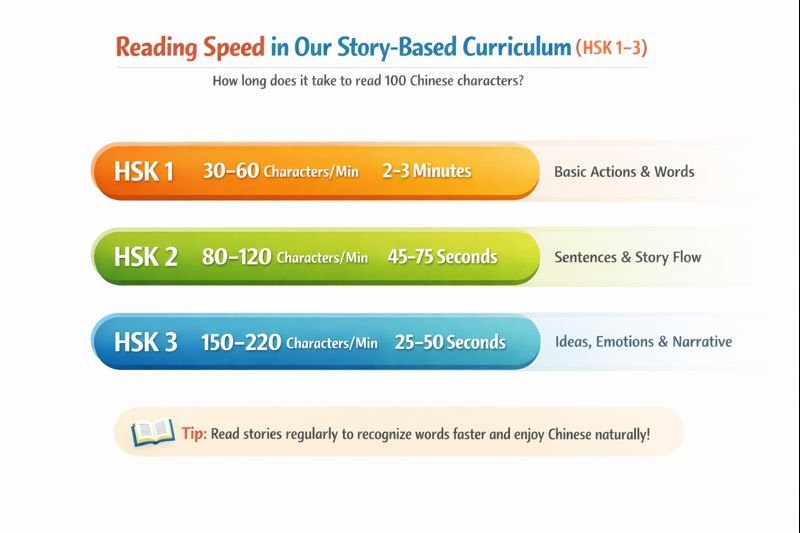
    Reading Chinese through stories is different from studying vocabulary lists. Here, the goal is following meaning and enjoying the story, not translating every character. As you progress from HSK 1 to HSK 3, your reading speed and comprehension improve naturally.

    HSK 1: Getting Used to the Story Flow

    • Recognize characters and basic words in context
    • Typical speed: 30–60 characters/min
    • Time for 100 characters: 2–3 minutes

    HSK 2: Reading in Chunks

    • Recognize whole words and simple sentence patterns
    • Typical speed: 80–120 characters/min
    • Time for 100 characters: 45–75 seconds

    HSK 3: Following Ideas and Emotions

    • Recognize multi-character words automatically
    • Understand grammar without stopping
    • Infer meaning from context
    • Comfortable story reading: 150–220 characters/min
    • Time for 100 characters: 25–50 seconds

    Healthy Benchmarks Across Levels

    Level Speed (characters/min) Time for 100 Characters Focus
    HSK 1 30–60 2–3 min Basic actions & words
    HSK 2 80–120 45–75 sec Sentences & story flow
    HSK 3 150–220 25–50 sec Ideas, emotions & narrative

    Tip: Read stories regularly to recognize words faster and enjoy Chinese naturally!

  • 23hsk2w03d07 第三周的回顾 – Review of the Third Week

    23hsk2w03d07 第三周的回顾 – Review of the Third Week

    Eduardo and Sabina spend Sunday evening reflecting on a week of major milestones. From surviving their first exam to navigating the healthcare system and enjoying local leisure, they evaluate their rapid progress in Mandarin.

    爱德华多和萨宾娜在周日晚上回顾了具有重大里程碑意义的一周。从通过第一次考试到在医疗系统中沟通,再到享受当地休闲生活,他们评估了自己在普通话方面的飞速进步。

    LEVEL/WORDCOUNT: HSK 2 / 650 characters

    body { font-family: Arial, sans-serif; margin: 0; padding: 0; background-color: #fdfdfd; } .container { max-width: 900px; margin: 20px auto; padding: 0 15px; } .tab-group { margin: 25px 0; } .tab-buttons { display: flex; justify-content: space-around; flex-wrap: wrap; gap: 8px; margin-bottom: 10px; } .tab-buttons button { padding: 10px 18px; cursor: pointer; background-color: #ffe082; border: none; border-radius: 6px; font-weight: bold; } .tab-buttons button.active { background-color: #ffca28; } .tab-content { display: none; background-color: #fff8e1; padding: 20px; border-radius: 10px; box-shadow: 0 2px 6px rgba(0,0,0,0.1); } .tab-content.active { display: block; } h2 { color: #2e7d32; margin-top: 0; } textarea { width: 100%; padding: 10px; border-radius: 6px; border: 1px solid #ccc; } .vocab-tooltip { border-bottom: 1px dotted #333; cursor: help; font-weight: bold; color: #2e7d32; } .vocab-tooltip:hover::after { content: attr(data-tooltip); position: absolute; background: #333; color: white; padding: 5px 10px; border-radius: 4px; font-size: 12px; white-space: nowrap; transform: translate(-50%, -120%); } .answer-tooltip { border-bottom: 1px dotted #666; cursor: help; font-weight: bold; color: #1976d2; } .answer-tooltip:hover::after { content: attr(data-answer); position: absolute; background: #1976d2; color: white; padding: 8px 12px; border-radius: 4px; font-size: 13px; white-space: nowrap; transform: translate(-50%, -120%); }

    第三周的回顾

    今天是星期日,上海的天气非常晴朗。爱德华多和萨宾娜坐在操场边的长椅上。这一周对他们来说非常特别,因为他们完成了很多“第一次”。

    萨宾娜笑着说:“我最开心的是周三的汉语考试。虽然准备的时候很紧张,但是看到好成绩时,我觉得所有的努力都值得。在茶馆喝茶庆祝的时候,我发现自己能听懂服务员说的很多话了。”

    爱德华多点点头,虽然他这周生病了,但他觉得很有收获。他说:“去医院看医生让我学会了怎么描述身体不舒服。而且,我这周学会了用手机点外卖,这让我的生活变得更方便。最兴奋的是参加了足球比赛,我们队还了!”

    两个人都觉得,这一周他们的汉语水平提高得很快。现在他们去超市买东西时,不仅能看懂标签,还能和收银员简单聊天。萨宾娜觉得,他们已经慢慢习惯了上海的生活节奏

    太阳快要下山了,爱德华多拿出了他的手机,拍了一张美丽的夕阳。他们决定,下周要尝试去更远的地方旅游。带着这一周的信心,他们已经准备好迎接二月的新挑战了。

    Dì Sān Zhōu de Huígù

    Jīntiān shì xīngqīrì, Shànghǎi de tiānqì fēicháng qínglǎng. Àidéhuáduō hé Sàbīnnà zuò zài cāochǎng biān de chángyǐ shàng. Zhè yī zhōu duì tāmen lái shuō fēicháng tèbié, yīnwèi tāmen wánchéng le hěn duō “dì yī cì”.

    Sàbīnnà xiào zhe shuō: “Wǒ zuì kāixīn de shì zhōusān de Hànyǔ kǎoshì. Suīrán zhǔnbèi de shíhou hěn jǐnzhāng, dànshì kàndào hǎo chéngjì shí, wǒ juéde suǒyǒu de nǔlì dōu zhíde. Zài cháguǎn hē chá qìngzhù de shíhou, wǒ fāxiàn zìjǐ néng tīng dǒng fúwùyuán shuō de hěn duō huà le.”

    Àidéhuáduō diǎndiǎn tóu, suīrán tā zhè zhōu shēngbìng le, dànshì tā juéde hěn yǒu shōuhuò. Tā shuō: “Qù yīyuàn kàn yīshēng ràng wǒ xuéhuì le zěnme miáoshù shēntǐ bù shūfu. Érqiě, wǒ zhè zhōu xuéhuì le yòng shǒujī diàn wàimài, zhè ràng wǒ de shēnghuó biànde gèng fāngbiàn. Zuì xìngfèn de shì cānjiā le zúqiú bǐsài, wǒmen duì hái yíng le!”

    Liǎng gè rén dōu juéde, zhè yī zhōu tāmen de Hànyǔ shuǐpíng tígāo de hěn kuài. Xiànzài tāmen qù chāoshì mǎi dōngxi shí, bùjǐn néng kàn dǒng biāoqiān, hái néng hé shōuyínyuán jiǎndān liáotiān. Sàbīnnà juéde, tāmen yǐjīng mànmàn xíguàn le Shànghǎi de shēnghuó jiézòu.

    Tàiyáng kuàiyào xiàshān le, Àidéhuáduō ná chū le tā de shǒujī, pāi le yī zhāng měilì de xīyáng. Tāmen juédìng, xià zhōu yào chángshì qù gèng yuǎn de dìfang lǚyóu. Dài zhe zhè yī zhōu de xìnxīn, tāmen yǐjīng zhǔnbèi hǎo yíngjiē èryuè de xīn tiǎozhàn le.

    Review of the Third Week

    Today is Sunday, and the weather in Shanghai is very sunny. Eduardo and Sabina are sitting on a bench by the playground. This week has been very special for them because they completed many “firsts.”

    Sabina said with a smile: “The happiest thing for me was Wednesday’s Chinese exam. Although I was nervous during preparation, when I saw the good results, I felt all the effort was worth it. When celebrating with tea at the tea house, I found I could understand much of what the waiter said.”

    Eduardo nodded; although he got sick this week, he felt it was very productive. He said: “Going to the hospital to see the doctor taught me how to describe physical discomfort. Also, I learned to order takeout with my phone this week, which has made my life much more convenient. The most exciting part was participating in the soccer match—our team even won!”

    Both of them felt that their Chinese level improved very quickly this week. Now when they go to the supermarket to buy things, they can not only understand the labels but also chat simply with the cashier. Sabina feels that they have gradually become accustomed to the pace of life in Shanghai.

    The sun was about to set, and Eduardo took out his phone to take a picture of the beautiful sunset. They decided to try traveling to a further place next week. Carrying the confidence from this week, they are ready to welcome the new challenges of February.

    Help

    How to Use the Audio

    The audio is designed to help you improve your Mandarin Chinese listening skills and pronunciation.

    • Before reading: Listen to understand rhythm and intonation.
    • After reading: Listen again to compare pronunciation.

    Vocabulary

    Characters Pinyin English
    收获shōuhuògains/results/harvest
    值得zhídeto be worth it
    兴奋xīngfènexcited
    习惯xíguànto be used to/habit
    描述miáoshùto describe
    标签biāoqiānlabel/tag
    收银员shōuyínyuáncashier
    挑战tiǎozhànchallenge
    长椅chángyǐbench
    夕阳xīyángsunset

    Grammar

    The Degree Complement with “De” (得)
    In HSK 2, is essential for evaluating actions. Sabina notes their progress: 提高得很快.

    Indicating Change with “Le” (了)
    The particle at the end of a sentence indicates a new realization. Sabina uses it for her listening: 能听懂…了.

    Idiomatic Expressions

    第一次
    A fundamental phrase for discussing new experiences. Example: 完成了很多第一次.

    慢慢习惯
    Combined with a verb, it shows a gradual process of adaptation. Example: 慢慢习惯了.

    Cultural Insights

    Reflecting on progress is a valued part of the learning process in China. Students often set specific goals at the end of a month.

    Campus life in Shanghai often revolves around the 操场. It serves as a social hub where students meet to chat and enjoy the sunset.

    10 Questions

    1. 今天天气怎么样? (答案)
    2. 他们坐在哪里? (答案)
    3. 萨宾娜这周什么方面最开心? (答案)
    4. 萨宾娜在茶馆发现了什么? (答案)
    5. 爱德华多去医院学会了什么? (答案)
    6. 点外卖让爱德华多的生活怎么样? (答案)
    7. 爱德华多的足球队赢了吗? (答案)
    8. 他们在超市能和谁聊天? (答案)
    9. 爱德华多拍了什么? (答案)
    10. 他们下周想做什么? (答案)

    Multiple Choice

    1. 这一周对他们来说怎么样?(答案)
      a) 很累
      b) 非常特别
      c) 很无聊
    1. 他们准备好迎接什么了?(答案)
      a) 考试
      b) 寒假
      c) 二月的新挑战

    True or False

    1. 今天上海的天气不好。 (答案)
    2. 他们坐在长椅上。 (答案)
    3. 萨宾娜觉得努力不值得。 (答案)
    4. 爱德华多学会了点外卖。 (答案)
    5. 爱德华多的队输了。 (答案)
    6. 他们的汉语水平提高得很快。 (答案)
    7. 他们不能看懂超市的标签。 (答案)
    8. 萨宾娜还没有习惯上海的节奏。 (答案)
    9. 爱德华多拍了夕阳的照片。 (答案)
    10. 他们对未来没有信心。 (答案)

    Retell the Story

    请用你自己的话重写这个故事。

    document.querySelectorAll(‘.tab-group’).forEach(group => { const buttons = group.querySelectorAll(‘.tab-btn’); const contents = group.querySelectorAll(‘.tab-content’); buttons.forEach(button => { button.addEventListener(‘click’, () => { buttons.forEach(btn => btn.classList.remove(‘active’)); contents.forEach(content => content.classList.remove(‘active’)); button.classList.add(‘active’); document.getElementById(button.dataset.tab).classList.add(‘active’); }); }); });